Born in Chickamauga, Georgia, John Dyer moved to Asia in 1956, when his father took an engineering assignment with a power utility.
He attended grades 1-12 at an international school, touring with his family through 29 countries before settling in the Midwest.
A computer scientist turned author of fiction, he is a founder of an IBM-affiliated software company, and an early innovator in electronic commerce. He brings a lifelong interest in science and engineering to everything he writes.
Our dog Ernie has separation anxiety. A 2-year-old dachshund mix, he is emotionally distant in all situations except one in which he is about to be left behind.
The river came into our lawn on Saturday. We had to leave the dogs at my sister-in-law’s. During the trip across town, Ernie wailed, he yodeled, he had an asthma attack.
It was not a surprise to learn about visitors from another planet, but the Sasquatch angle — furry migrants with birth rights going back to the Ice Age — that was a showstopper.
The average Earth native is excited. The global elite are freaking out. In Washington DC, U.S. President Carmen Benequista is juggling red-hot pokers, and she’s tired of it.
Let's see if we can make it fit on the back cover. 254 words.
In Old Testament times, co-occupancy with migrants from another planet was, for humans, like having a rich uncle who stopped answering the door. And then, in 48 BCE, the Alexandrian Library burned down. Evidence destroyed. The Anye faded into the shadows and we forgot about them; until recently, when a 1×2 kilometer starship showed up at the Dust Cloud, there to rescue Earth from cosmic disaster.
“Not so fast”, said the global elite. “What’s in it for us?”
United States President Carmen Benequista is dealing with a mutinous Congress, in no mood to entertain a dream séance, during which her deceased husband says, “Find someone to share your life.”
The Kata AjJivadi, codified 48 BCE, commands that the planet Jivada’s influence on Earth shall be hidden from view — impractical unless someone destroys evidence at, for instance, the Shrine of the Muses in Egypt, next door to the Alexandrian Library.
It was arson. Nobody denies it. Consequently, in a single stroke, barring the occasional Sasquatch sighting, the Anye Migration and its many aspects were relegated to mythology.
In some circles, the prologue is apostasy. However, in the case of Maroli Tango, this might be essential. Comments welcome.
Previously …
The effective date of the Anye Disclosure was arguable, conceivably pointing back to 1928, when the executive host of an off-world-patronized South Dakota tourist destination revealed herself to Doctor Elbert Holland Harrison, a rural physician of the human persuasion who, up until then, had not been in on ‘the big secret’.
“Good evening”, she had said, lemur fangs concealed behind a demure smile. “We’re from the Sasquatch chamber of commerce.”
The proposition was not as risky as one might think. Doc Harrison, an 83-year-old veteran of the American Civil War, was a person made stoic by a lifetime of experience with suffering.
Confronted by a furry foxlike princess wearing a tailored western-cut maternity blouse, culotte skirt and cowboy boots, he thought to himself, ‘Aren’t you the prettiest little thing?’
Earth’s secret history was explained — 25,000 years as a backwater campground, and yet for all the opportunity presented, humans had not become the unwitting subjects of a celestial master race.
The lady told him, “It’s like having a rich uncle who stopped returning your phone calls.”
Jivada, an Anye colony world, was one-hour-forty-five-minutes away via Saraf Drive. A third of Jivada’s citizens (AjJivadi) were human, welcomed into Anye clans since the Migration.
The AjJivadi possessed homestead claims on Earth, anchored by business enterprise, dual citizenships, voluntary submission to taxation, and so forth.
Their engagement from the shadows, a practice formalized around the time of Jesus, was not a sign of consent to be marginalized.
Evidence two artifacts of Jivada’s agency on Earth:
The ancient and noble order of Zirna Zapha, a custodian of Anye civilization, formed on pre-industrial Vidura (the home planet) by militant SagGha priests. Sanskrit – The Broken Claw. Colloquial – Zeze; The Space Mafia.
CH Banks International, a private security firm and, some would say, a Zirna Zapha storefront. Incorporated 1929, Black Rock, South Dakota.
In 2025, nearly a hundred years after Doc Harrison received a lesson in clandestine symbiotic co-occupancy, an approaching cyclical catastrophe shifted the Disclosure into high gear.
Jivada dispatched an emissary to offer intervention, the very same Doc Harrison, now 180 years old, although he didn’t look it.
The mission culminated in a shootout at a taco joint near Holloman Air Force Base in New Mexico, an exploit by the U.S. military to hijack a space yacht, ransom the owner, and ship the proceeds to defense contractors in exchange for lucrative kickbacks.
The USAF suffered grave casualties. Doc Harrison departed the scene on a Triumph Speed Triple motorcycle in the company of a shapely 26-year-old social media skydiving celebrity, to rendezvous with the space yacht Skeezix in the parking lot of a local Wal-Mart.
A filmic spectacle, captured in Super 3D UltraVision by a covey of Anye-tech fighting drones, even and especially while engaged in shooting the enemy.
Both Wal-Mart and the Triumph Motorcycle Company were grateful for the publicity, but it was a crushing defeat for the military-industrial complex, an object lesson, an opportunity to change course.
Which they ignored in favor of a mutiny against the President of the United States, a guerrilla war against Jivada, and a worldwide pogrom against AjJivadi constituents on Earth.
None of it worked to their advantage. The Anye Disclosure and its benign intentions gained more than enough traction to persuade the general public, despite opposition.
On a side note: the nomenclature ‘First Contact’ was preposterously out of date. The Disclosure was a ‘Gazillionth Contact’ event; except this time, it was meant to stick.
And regrettably, Earth’s global elite were nowhere near being ready to go along.
I’ve recently given myself the objective of crafting an opening to the current work-in-progress so compelling that every reader will be enthralled, no matter what kind of book they’re in the mood for.
Exhibit 1: An early-draft description for Maroli Tango:
Sometimes, no matter what’s going on, you have to make it about you.
Visited in a dream by her deceased husband, United States President Carmen Luisa Benequista gets a wake-up call. Anton Benequista, gone these past 13 years, tells her, “Find someone to share your life.”
It’s not a rocket science proposition. Carmen’s steady companion, Space Mafia kingpin Brandon Lopez, 15 years her junior, is waiting for a signal. Done deal, if she wants.
First-contact survivor Mason Fowlkes, soon to be 16, is growing up fast as an apprentice Ship’s Mechanic aboard the Anye migration vessel Anuraga. The work life is great; the home life not so much.
French Air Force lieutenant Marie Jourdaine is on the rebound after a brief stint as the world’s youngest female fighter pilot. Things are kind of working out, and kind of not.
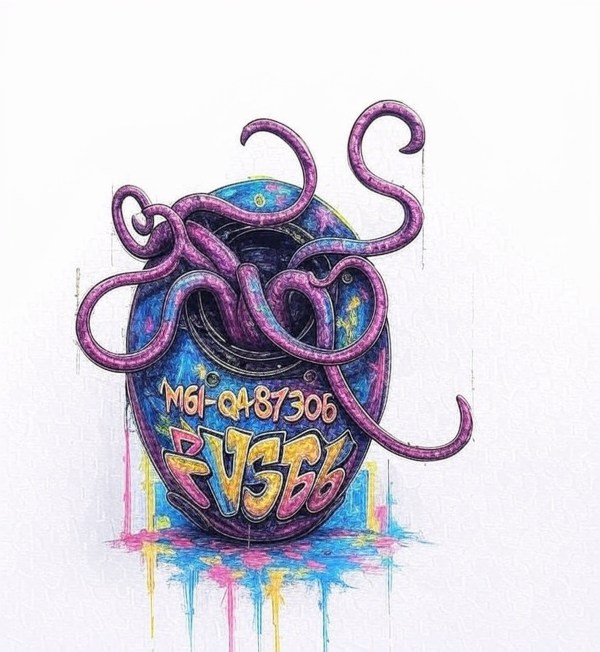
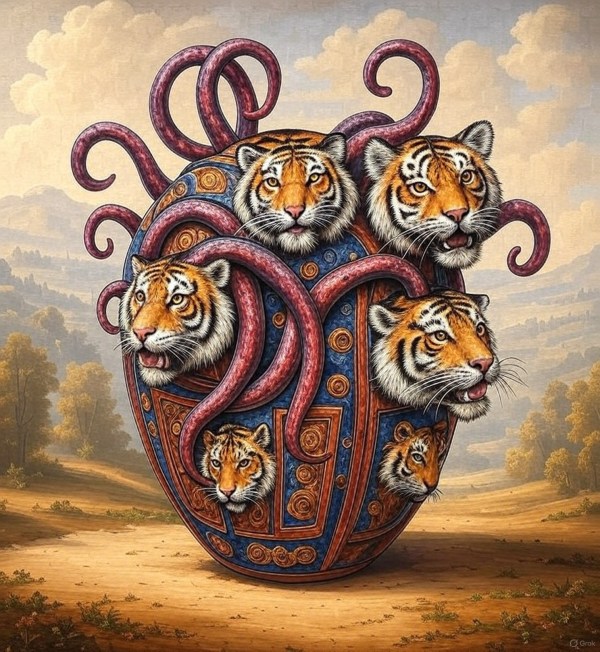
Caught in the middle is Chester, an elevated maroli labor appliance, a product of ancient Anye technology, monstrous in appearance, sweet of disposition, intent on discovering his place in the universe.
It’s been a bumpy ride, fraught with challenges. Maybe it’s time for our heroes to take care of themselves.
‘Trust the reader’ is a bit of advice I took to heart at the beginning of my author’s journey, on the topic of balancing exposition against pacing, and the value of a fly-on-the-wall third-person-limited narrative form, a staple in the writing of Hemingway and others. It suits me. It’s what I do now. I’m not about to change, although the critique gives me pause.
Mom was the artist of the family. Philippines, 1967. Norma Jean Roberts Dyer Razovsky posing at her easel, mid-blink, in the company of Alan Maury Razovsky (Dad) and little Johnny Dyer (me).
We can’t tell what she was working on due to harsh lighting, but it had to be amazing because Mom was good at it. However, in the acorn-tree department, yours truly once drew a circuit diagram on posterboard for a science fair project (1963), and to this day, that is the extent of what I can do with a drawing instrument.
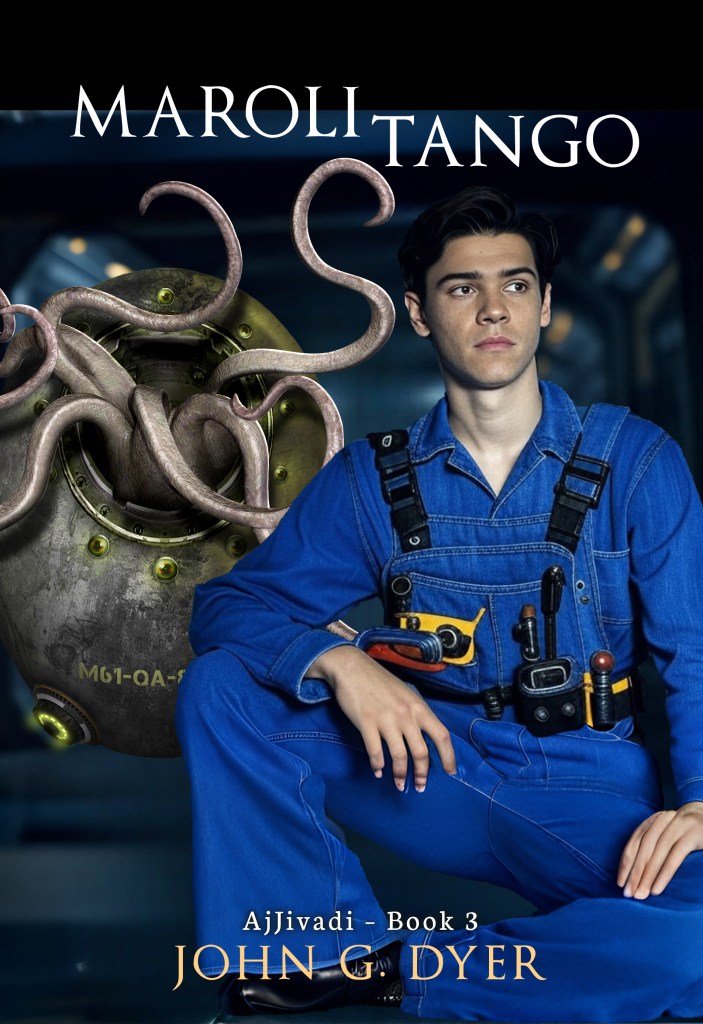
I am, however, an advanced novice on Adobe Photoshop — and what a great tool that is, especially when reinforced with a dollop of AI software IP theft facilitator, or whatever the kids are calling it these days.
Turn away in disgust if you must, but that’s how I did this.
Now that you’ve noticed creepy fingers on the right hand, you can’t look at anything else, can you? AI is notorious for glitches — Mason’s neck is too long, the lighting is off, color balance is iffy, and it looks like a paste-up job, which it is.
Never mind. This is just a placeholder for the actual cover, which will be developed by an artist, unless I attend a seance during which Mom teaches me how to paint.
In the meantime, this illustration will get me through the pre-release phase, during which authors traditionally leak WIP chapter excerpts into the ether, a tried-and-true means of inciting readers into an anticipatory frenzy — such as you might be experiencing right now.
May I suggest you visit my catalog to satisfy your cravings until publishing date. July perhaps, unless I perform another massive rewrite, which is not out of the question.
So, answer me this: Does my first mockup cover elicit comparison to Japanese tentacle erotica?
I completely forgot such things existed; and by the way, I have discovered services that animate illustrations for free, and worth every penny of it.
Maroli Tango cast members posing for a promo. You can’t get a maroli to stay still.
Mason Fowlkes out of costume. Mind you, I have no idea how this happened. Might have been something I said.
Did I mention you should buy my books? Also, are you an artist? Are you aghast at my brazen use of AI? Do you know how to paint hands? Tell us in the comments.
Approaching 2 years into what will be my seventh published novel, I am still in the process of discovering what the book is about.
Life, certainly; but what else? The manuscript is currently 85,000 words, the ‘excised’ document 70,000.
The conclusion is envisioned but not written down. I’ve now gone back to the opening chapters, seeking to clarify the theme, motivate the reader, apply craft, say something important, break new ground.
This is not a complaint. I’m reporting on the process. It’s a form of therapy, common to the activity.
In other news, I’ve been told my stand-in cover design (a concept, composed to accompany WIP essays) elicits comparison to Japanese tentacle erotica.
First off, my audience isn’t supposed to know such things exist.





 John Dyer Writes
Recent Comments