Primed!

I re-enrolled my books in the Kindle Select program. Jump in with your Amazon Prime or Kindle Unlimited subscription and read them for free!

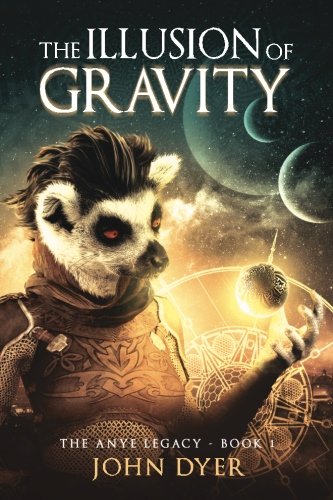
Find my titles on Amazon here!

I get paid by the page. So, you know, hang in there.

In other news, I wrote the final chapter for Habit of Providence just this week. The first book in the AjJivadi series, Elbert, is up for a third editing pass, then I’ll edit Habit again. Look for new books in July.

Metaphysical-ish

A teaser from 'A Habit of Providence'. the current novel-in-edit.

The Anodyne Virtuality

Aswang the errant fighting drone had made a preliminary reconnaissance pass at the Pacific Pride gas station in Mount Angel, capturing enough data to assemble a VR scene in Anodyne Workbench, through which one could meander if implanted with a neural interface.

The drone had a sense of smell, recording the aromas of diesel fuel and Double Bubble in a vicinity where the pickup truck’s rear bumper faded from sharp to fuzzy, a result of spotty image coverage. Pam was disappointed. “The convenience store is in focus from where I’m standing, but the truck drops into low-res at knee-height in back. I can’t read the license plate.”

Continue reading “Metaphysical-ish”

Gothic Space Opera

1928. Flying from Jivada to Earth. See the featured image to learn what the spaceship looks like.

Loyal House — In transit

Elbert raised the shutter on a window next to the front door, peering across a floodlit lawn into the infinite void of N-Space — shapeless, featureless, blacker than night, held off at the fence line by Saraf Drive emitter arrays, arching over the house like a sea monster’s ribcage, pylons engulfed in swirling webs of blue fire.

The house Oma recited a passage from the owner’s guide. “Depending on the intensity of exterior illumination, passengers may witness, at the envelope boundary, an effect of near-field spatial distortion acting upon available light, compressing wavelengths toward the violet end of the spectrum.”

Roman said, “In other words, the pylons aren’t shielded.”

“I’m sure it’s dangerous to get near them.” Elbert lowered his voice. “But how far away is far enough?”

“Are you thinking about going out there?”

“We’re not leaking atmosphere.” Elbert put his chin against Armor Glaze, craning his neck. “It’s quite a spectacle.”

They went four steps down from the top of the front stoop, just enough to look past the overhang. The air was dead still, the grounds deafeningly silent, every feature outlined in sharp contrast, individual blades of grass throwing deep shadows into turf.

Francine stepped across the threshold; voice dampened by ambient phase cancellation. “What’s it like.”

“Spooky as hell.” He nudged Elbert. “You’re a brave man, Doc.”

“For about a minute, anyway.” Elbert took his elbow. “Let’s go back in.”

Readier to Read!

Elbert — Act 1: Earth’s Secret History (Second Edition) is live on Kindle Vella!

In 1928 South Dakota, a rural physician learns about life on other planets, and a bounty of opportunities available to those who know. Eighty-three years old, Doctor Elbert Holland Harrison thought he was waiting to die. Now he’s waiting to live.

Elbert is a story about relationships, self-discovery, and the necessity of facing the future with courage and compassion.

On the advice of editor Jon Oliver, I added a new first chapter. Potential confusion about a variety of Anye Universe concepts has been mitigated.

The complete novel is in edit at 94,000 words. I expect to publish before year end, but you can read Act 1 on Kindle Vella for free, simply by signing up for the service and accepting a starter kit of 200 tokens.

You don’t have to be a fan of SciFi — I’m doing something out-of-the-ordinary, and this book in particular should be satisfying for readers of every genre.

I’ll be grateful if you give it a try, and doubly so if you leave a review.

Edited unto morbidity

When I posted this essay a few days ago, I thought I was done editing this chapter — that I’d be showing off what came of it and move on. Today, on December 20, 2021, after thirty-plus revisions over four different approaches, the headline is more appropriate than anticipated.

An engagement with editor Jon Oliver had produced the assessment that my novel-in-progress is in good shape, although not quite suitable as an entry point for new readers of Anye Universe material. The work needed, he said, a prologue.

Author/Editor Joan Dempsey advises against backstory-laden first chapters, but I thought to give it a try. Six-thousand-plus words and five different approaches later, I think Joan’s recommendation is the one I’ll go with. It was not a waste of time — usable material was developed, but it won’t go into a prologue.

For those interested in process, here’s the second-to-last draft. The last one contains text I’ll fold into the book.

Have you ever struggled with a first chapter? Tell me about it in the comments.
Continue reading “Edited unto morbidity”

Double-Played

What author hasn’t imagined seeing his novel played out on the big screen? I certainly did, and if you’ve been following this blog you know I took at stab at writing a film adaptation of my novel Silken Thread.

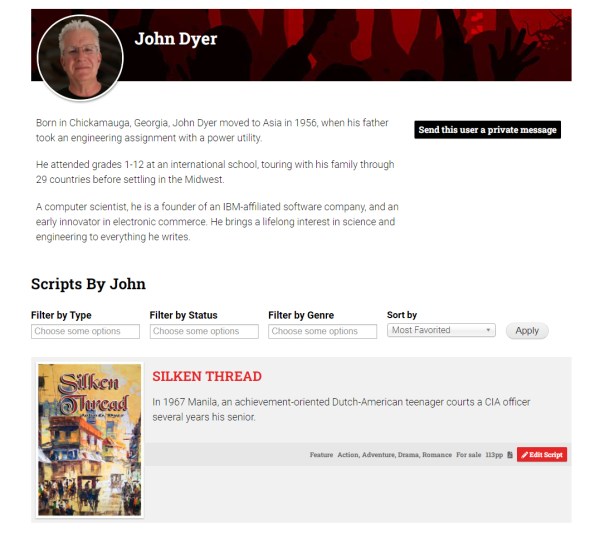
I paid a fee for script coverage, during which I learned it’s harder than it looks. And then, lesson in hand, I took another crack at it, which you can see on the Script Revolution website by the artful use of your mouse pointer (slightly left, please).

I’m done trying that – but what the heck, might as well put it out there. To say I’m satisfied with the second draft is a stretch, but it was an enlightening story structure exercise. To wit – it made me focus on the elements of storytelling and the value of the three-act form.

But I find that screenwriting is a) heavier on craft than expression and, b) focused on selling an idea to other artists, after which art may or may not be forthcoming. I might persist if I was looking for a job, which I’m not.

All that said, the effort might conceivably influence my approach during the editing process.

Are you a novelist? How much effort do you put into concepts like ‘beats’ and story models when you’re writing?

Played out — John Dyer Writes

Earlier this year, I submitted my first-ever attempt at writing a screenplay to a smallish indie filmmaker, arranged through a service provided by Stage32. A producer had issued a call for coming-of-age stories, and my novel Silken Thread kind of fits. In 1960s Manila, an American teenager courts a CIA officer several years his senior. Novel here, screenplay here, if you’re curious.

Spoiler alert — I was not offered a movie deal.

I was told I’d written a novel but not a screenplay. Also …

  • The story is missing the exciting parts of the protagonist’s life until the last 20 pages (during which the hero almost dies).
  • The narrative structure should adhere to the three-act form.
  • The author should pay attention to story beats.
  • There’s not enough drama.
  • The author should ask the question, “Why would anyone want to watch this?”
  • The hero David Aarens is a person who never says ‘no’ to the challenges in his life.
  • The document layout does not “look like a professional screenplay” and I should use Final Draft as an authoring tool.
Continue reading “Played out — John Dyer Writes”

Blog at WordPress.com.

Up ↑