Camera Familia #22 — John Dyer Writes

Manila, Philippines. Circa 1958. A year before this photo was taken, Mom took me to visit a friend who lived in an apartment near downtown Manila. I had never been in an apartment before. I didn’t even know such things existed.

The lady had a dachshund named Gretchen. I had never seen a Dachshund before.

Gretchen knew a trick. The owner balanced a cookie on the dog’s nose. The dog stood still. The owner said, “Okay.” The dog flipped the cookie into the air, and ate it. I had no idea dogs could learn tricks.

Gretchen had a litter of puppies. I had never seen puppies before.

Can you believe it? I was seven! Anyway, we took one home, and someone in the family, probably Mom, named her Hildegard. We called her Hildy. Years later, Mom claimed the dog’s name was actually Brunhilda. It was Hildegard. These were important events for me. I remember everything about it.

One day, Hildy had puppies. I had no idea how that happened, but I got to pick one for us to keep. I named him Mercury. We called him Mergy.

These were standard Dachshunds. Mergy weighed about twenty pounds as an adult. See the photo, Mergy and me, circa 1965.

It never occurred to anyone to teach these dogs tricks, but they did have a behavior. They hunted rats, big old Chinese Brown Rats, about a third their size. They’d bag them early in the morning, after Lucina got up, and stack the bodies on the front porch. Dad would come out for the newspaper to find Hildy and Mergy guarding their catch, waiting to be praised.

Technically, Mergy was my first pet, and I’ll always remember him that way — but both dogs slept with Lucina, so they probably thought they were hers.

At the time, I had no idea that was an option.

If you're enjoying these essays, please subscribe.

Camera Familia #21 — John Dyer Writes

Manila, Philippines. Circa 1958. I remember very little about my enlistment in the Philippine Cub Scouts, but there’s no refuting photographic evidence — I was in it. There was a guidebook, tasks to accomplish, skills to acquire. We must have gone on outings. I appear to have made acquaintances. I don’t recall any unpleasant moments.

The goal of the organization was to build virtue, self-reliance, good citizenship. As far as I know, it worked.

If you're enjoying these essays, please subscribe.

Camera Familia #20 — John Dyer Writes

Botocan, Philippines. Circa 1957. The life we imagine for ourselves is not necessarily the best life for everyone, but ideas will spread, and people will make choices. Filipinos valued their culture, but postwar Western nations had a lot to offer.

Population was expanding. Cities were growing. Modernization outward was essential, if for no other reason than to increase crop yields. In the provinces, traditional ways would eventually be displaced.

Thankfully, we were there in time to witness that which came before. In the photo, a man smiles at the camera, apparently serene, living in the moment. At arm’s length, a water buffalo, a cart, a harvest. I suspect he knew, as all of us should, that the most important things in life are usually right there, at arm’s length.

If you're enjoying these essays, please subscribe.

Camera Familia #19 — John Dyer Writes

Manila, Philippines. Circa 1957. Hard times make people grow up faster, a quality that can often be seen in photographs. My siblings were born in 1941, at the beginning of World War II. Some of their peers were toddlers at the Santo Tomas prison camp during the Japanese occupation.

A few, like my brother, arrived in Manila half-grown, rough and tough. Mike used to hang around the Manila Yacht Club waiting for members to get off work. He crewed sailboats, raced dinghies, explored the caves at Corregidor, and put some adventure under his belt.

My shift started during the prime rib buffet. Mike left for college. Our parents played golf. Mom was in art class. My cousins were hunting, fishing, racing jalopies around the back roads without drivers licenses, but they were half a planet away. There was nobody to show me how to do those things.

I’m not complaining. I had a great life growing up. My wife says she’s jealous. Mind you, she was riding motorcycles at the age of eleven. I could easily be jealous of that.

In the photo on the left, my brother Mike dancing with our stepsister Carolyn. On the right, their friends, also sixteen years old, looking way more grown up than I did at that age.

If you're enjoying these essays, please subscribe.

Camera Familia #18 — John Dyer Writes

Manila, Philippines. Forbes Park, 1956. Around the time of this photo, I asked Dad why we rarely saw my classmates at the Manila Polo Club. He replied, “Not everyone can be a member.” I was too young to process the long explanation but there was, for instance, a ceiling on enrollment. One needed a sponsor. You had to be voted in. It was expensive. Some folks lived on the beach, or had swimming pools, or spent all their time at the golf club. Being able to walk through the front door at MPC didn’t necessarily make us special.

So, this is what that looked like.

The club had (has) a twenty-five meter swimming pool, tennis courts, badminton courts, a duck-pin bowling alley, riding stables, party houses, a ballroom. Even at the tender age of six, I could see our life had experienced an upgrade.

My mother, and stepsister Carolyn, waxing glamorous on the low board. We weren’t in Flintstone, Georgia anymore.

If you're enjoying these essays, please subscribe to receive notifications.

Camera Familia #17 — John Dyer Writes

Manila, Philippines. 1956. Lucina de Llacuna was poised, dignified, and rich with virtue. Also kind, steady, cheerful but not jolly, a bit on the stoic side as witnessed by the photo. According to my brother Mike, Lucina was plenty shrewd enough to handle our mother, which might explain how they got along. No disrespect intended to Mom, but consistency was not her strong suit.

Lucina was from Laguna de Bay, which I always assumed bore some relationship to her surname. It did not. Taxonomy — Llacuna, a town near Barcelona, Spain. I didn’t look into it until starting this essay.

We never knew her age. Malays have a tendency to wax ageless. The information was not volunteered. Dad thought it would be impolite to ask. We’re thinking close to Dad’s age, forty-one at the time.

My parents may or may not have known what became of Lucina’s husband. If they did, it was never mentioned. I was six. Lucina was my amah. My instructions were to show respect, do what she told me, and stay out of the way. At no point in our relationship did she tell me the story of her life, and I can’t say I was curious about it. I knew my Uncle Bill for fifty years, and never asked him any questions either.

Occasionally, in the presence of my parents, Lucina might say in Tagalog something along the lines of, “I know what time you came in last night” — without using the word ‘hala’ (shame on you), because they knew what it meant. I wasn’t afraid she’d tell on me, but her approval mattered. I would ask forgiveness, and make promises I couldn’t keep. It was a ritual, an affirmation of her authority, and a great deal more. I’m sure it brought her joy.

Lucina stayed with our family for the duration — eighteen years. Dad established a pension account in a Manila bank. Last I checked, it was still paying out. That would have made her one-hundred-nine at the time. It’s not impossible, and besides, there are boundaries to honor. If she was still living, good for her. If not, it’s none of my business who’s cashing the checks.

If you're enjoying these essays, please subscribe to receive notifications.

How to build an alien death ray

Another teaser from a work-in-progress novel, demonstrating that it's hard to write hard science fiction. This bit might have flaws, as I've never actually built a laser. Comments from those who have are solicited.

Chapter 167

Titan Pass, Nevada

Lasers are uncomplicated devices, but as one scales them up, they can be challenging to build. Small gas and ruby lasers are easy to make; but if one desires a large-scale diamond laser, he’d better have on hand an assortment of supplies and tooling.

Borosilicate glass pipe, taken off the bill-of-materials of a coal dust combustion reactor (for a never-to-be-assembled abrasives processing line), makes a fine armature for a lasing rod.

Insert the pipe into the chuck of a CNC lathe/vertical milling machine, trickle in refined diamond grit, pulse into a liquid state with an Anye-tech fuser mounted to a servo-driven tool arm, manipulating crystal lattice structure with components made for a quantum assembler (which you will also never finish).

Dope the mix with semiconductor manufacturing chemicals, forming internal optical circuits. Measure with a full-spectrum LED shop light and high-resolution imager (a phone camera).

Mirror coat the borosilicate pipe. Apply a suspension containing light emitting precipitate (Anye-tech homebrew chemistry) to plastic-backed graphene mesh (Japan), and wrap that around your pipe. Tap the graphene mesh for power. Finish the assembly with parasitic cooling tape (from your nanoscale fabricator) and Plasti Dip automotive wheel paint (RockAuto).

Walla! You now have in your possession a thirty-seven-centimeter-long laser core which, when powered, is capable of instantly destroying meter-thick concrete. It’s also past midnight, you’re dead tired, and you haven’t built a flying platform yet.


Note – Featured image by Tom Edwards, a UK cover artist.

Poetizing

Some authors read while they’re writing, a way of drawing inspiration from the mechanics of how another tells a story. I won’t say it’s a bad idea, but it doesn’t work for me – whatever I gain is cancelled out by an extrinsic narrative competing for space in my thoughts.

Recently, however, the poet River Dixon volunteered to read one of my novels. I thought I might reciprocate and, to my surprise, I find I can read poetry without forgetting what I was trying to write. The man knows how to turn a phrase – visit him at The Stories In Between.

Continue reading “Poetizing”

Blurbed.

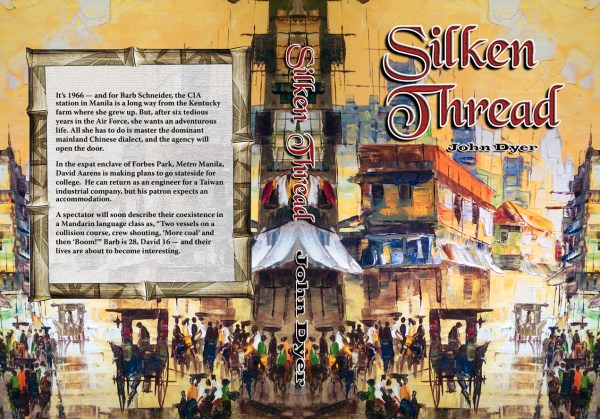
It is said that it’s a waste of time to do much in the way of marketing until one has at least 3 books to sell. Well, I now have 4 books published, so I suppose it’s time to review the essays I’ve been hoarding on my bookmarks bar. You know the ones – “How to turn your inane ramblings into a #1 Best Seller in 5 easy steps.” 

Fortuitously, Ricardo Fayet over at Reedsy sent me an email the other day – me and probably 150,000 other people, not that I’m complaining – entitled The Ultimate Guide to KDP: How to Succeed on Kindle Direct Publishing. I’ve seen this advice elsewhere – but it’s neatly organized and, as far as I can tell, all the salient points are covered.

Number 1 – Create a polished cover.

I think I have that, even though I didn’t use Paul Trif at TwinArtDesign for Silken Thread, choosing to do that one myself. I know – that’s often a mistake. Paul made 3 great covers for my Anye Legacy books and there’s no reason to think he wouldn’t do it again. Be sure and tell me if you think I’ve goofed on this one, otherwise I’ll blissfully move forward not knowing any better. Continue reading “Blurbed.”

Blog at WordPress.com.

Up ↑