Disclosure

Another teaser from Elbert, in which the lady meets a fellow with large teeth. The featured image is a second pass at the cover illustration by Paul Trif at Twin Art Design.

South Dakota, 1928

The rented aircar arrived early, giving time for the three of them to dawdle while hashing out a plan. Doctor Falun ran out to the island off Mexico where his fellow space yacht owners tended to congregate, but nobody was there. It took two minutes to go the distance, which Elbert found astonishing. “But it’s not faster than light?”

Falun shook his head. “In theory, the vessel stands still for an instant and the universe moves around it.” He returned Elbert’s gaze without blinking. “I’m not kidding; that’s what they think.”

Tom got his pants wet walking in the surf. Everyone tracked sand into the car. Falun produced a hip flask of single-malt scotch; Elbert took a capful before realizing Charlotte might think he was drunk, then had another because it was too late to take it back.

Continue reading “Disclosure”

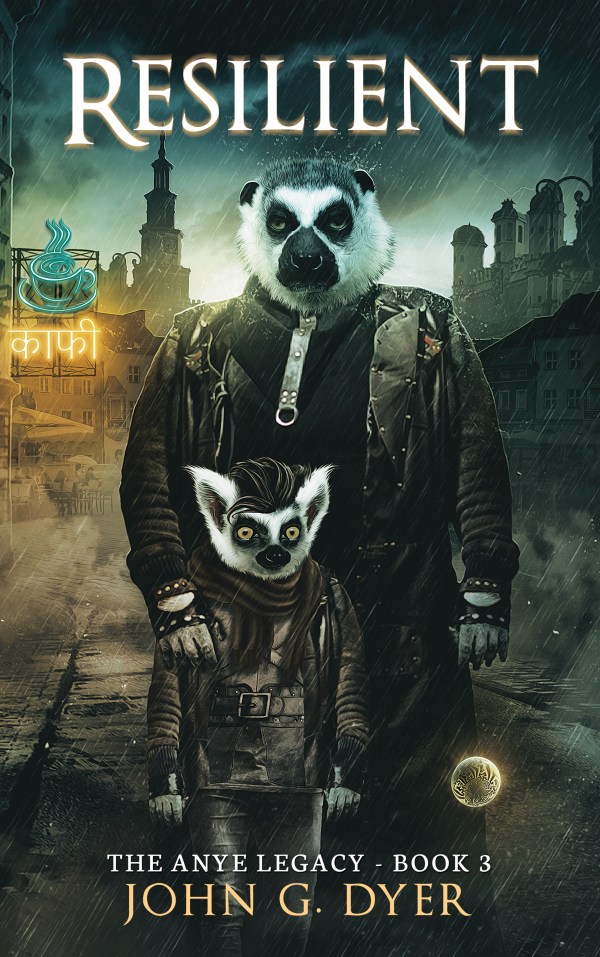
I gave away 54 eBook copies of Resilient

And it’s as though I’m holding 54 lottery tickets, each with a non-specific settlement date. Will anyone read the book? Will there be reviews? What will they say?

To make matters worse, I read a couple of chapters after submitting the promotion. It’s been 3 years since publication, and damned if I shouldn’t have put the inciting event closer to the first chapter. Not that I’m embarrassed; I’m still proud of what I did.

Until this week, Resilient had reached maybe 6 readers. Now, I guess, we’re going to find out about market acceptance. Did you order the book? Have you started reading yet? Comments invited!

The Art of Not Explaining Art — John Dyer Writes

In a video essay entitled The Nightmare Artist, YouTube creator In Praise of Shadows tells us about Zdzislaw Beksinski, an artist who emerged from the horrors of WWII Poland to produce a collection of stark, gloomy paintings. Beksinski never titled his works nor would he consent to explain himself except to say things like, “Meaning is meaningless to me” and “Interpretation is imposed by others”. Of course, that didn’t stop critics from saying what he was about, but I think he was smart to be silent. Certainly, if he’d said — about any one thing he did — “This is how I felt when the Jews were taken away”, then everything he produced would have been defined by the statement.

Continue reading “The Art of Not Explaining Art — John Dyer Writes”

Ghana, 1929

Another teaser from my WIP novel Elbert. 

January, 1929. Broken Claw enforcer Stefan Tot takes our heroine Charlotte Banks along on a delivery run.

Nasia Basin, Ghana

The 5,000-kilometer flight into northern Ghana took all of five minutes, after which the shuttle dallied above the landing zone while Stefan and his men debated what to do about three locals squatting next to their truck.

Charlotte listened to the discussion with one ear, attention focused on the feed from a Raksa drone sent down to spy on the interlopers. Stefan chose his words carefully — mindful, she thought, of the pilot’s sensibilities. “They’re up to no good, but I don’t want to shoot them over something like this.”

She smiled to herself. You would, if it was just us. “What do we have to trade?”

Continue reading “Ghana, 1929”

How to buy a flying motorhome on Jivada

Another work-in-process teaser, this one from Elbert, the first book in the Anye Constituency series. Illustration by Khoi Anh

Badari

The seller was a goat farmer, living on the rocky north coast not far from the SagGha temple where Guru Orsa disembarked the day they met him. He was Mahat Limar, talkative, apparently richer than King Midas, having a leasehold spanning a huge tract of land dotted with feed stalls and animal shelters.

The travel coach was kept in a barn, a space dedicated more to veterinary science than goat hospitality, but there was community on hand. Charlotte would have taken one home if she had a place to keep it. “This female is adorable!” Continue reading “How to buy a flying motorhome on Jivada”

The Vigil

I’ve been watching my KENP stats this month, which reveal that someone’s been reading my books!

It seems likely that it’s one reader, but the app doesn’t reveal that information – and there’s a blip on May 16 suggesting a person (maybe the same reader, maybe not) finished Silken Thread in one sitting.

Regardless, someone is consuming 30-60 pages in the Anye Legacy series every morning. If it’s one reader, then that person must have liked the first book, because Quantum Soul picked up on the chart a day after the page count for Illusion of Gravity dropped off. I can’t wait to see if Resilient pops up next.

It’s like a lottery ticket in my pocket. Am I about to be discovered? Woo!

I don’t have a punchline for this post, except to say – if you’re intrigued, check out my books. You might be next on the chart!

Keep reading. We need you.


How to build an alien death ray

Another teaser from a work-in-progress novel, demonstrating that it's hard to write hard science fiction. This bit might have flaws, as I've never actually built a laser. Comments from those who have are solicited.

Chapter 167

Titan Pass, Nevada

Lasers are uncomplicated devices, but as one scales them up, they can be challenging to build. Small gas and ruby lasers are easy to make; but if one desires a large-scale diamond laser, he’d better have on hand an assortment of supplies and tooling.

Borosilicate glass pipe, taken off the bill-of-materials of a coal dust combustion reactor (for a never-to-be-assembled abrasives processing line), makes a fine armature for a lasing rod.

Insert the pipe into the chuck of a CNC lathe/vertical milling machine, trickle in refined diamond grit, pulse into a liquid state with an Anye-tech fuser mounted to a servo-driven tool arm, manipulating crystal lattice structure with components made for a quantum assembler (which you will also never finish).

Dope the mix with semiconductor manufacturing chemicals, forming internal optical circuits. Measure with a full-spectrum LED shop light and high-resolution imager (a phone camera).

Mirror coat the borosilicate pipe. Apply a suspension containing light emitting precipitate (Anye-tech homebrew chemistry) to plastic-backed graphene mesh (Japan), and wrap that around your pipe. Tap the graphene mesh for power. Finish the assembly with parasitic cooling tape (from your nanoscale fabricator) and Plasti Dip automotive wheel paint (RockAuto).

Walla! You now have in your possession a thirty-seven-centimeter-long laser core which, when powered, is capable of instantly destroying meter-thick concrete. It’s also past midnight, you’re dead tired, and you haven’t built a flying platform yet.


Note – Featured image by Tom Edwards, a UK cover artist.

Space opera!

This is a teaser from what will probably be Book 6 in the Anye Legacy series. The working title is A Habit of Providence. I’m having fun, and I thought I’d share. Enjoy!

International Space Station — Earth Orbit

The International Space Station crew crowded against a viewport, taking pictures and waving, but the mission commander was inhospitable over the radio. “We’re not supposed to talk to you.”

“I don’t know what to say to that.” Elbert tossed a token into the augmented reality workspace. “Feel free to jump in.”

Pam instantiated a virtual push-to-talk widget; it felt rubbery, rough on one side, like it was really there, a surreal artifact of the universe she’d entered. “I’m Pamela Carlson, United States Army Reserve, and we’d really like to have a conversation.”

“Miss; I have the radio. Conversation over.”

Pam nudged Elbert on the shoulder, pointing out a handwritten sign taped to the inside of the viewport, saying ‘4 bars! millietheastronaut@spacecenter.de’. “It looks like you left your cell tower emulator on.”

It took ten minutes to strike an accord with the rest of the ISS crew and get on their way.

Poetizing

Some authors read while they’re writing, a way of drawing inspiration from the mechanics of how another tells a story. I won’t say it’s a bad idea, but it doesn’t work for me – whatever I gain is cancelled out by an extrinsic narrative competing for space in my thoughts.

Recently, however, the poet River Dixon volunteered to read one of my novels. I thought I might reciprocate and, to my surprise, I find I can read poetry without forgetting what I was trying to write. The man knows how to turn a phrase – visit him at The Stories In Between.

Continue reading “Poetizing”

Blog at WordPress.com.

Up ↑