Double-Played

What author hasn’t imagined seeing his novel played out on the big screen? I certainly did, and if you’ve been following this blog you know I took at stab at writing a film adaptation of my novel Silken Thread.

I paid a fee for script coverage, during which I learned it’s harder than it looks. And then, lesson in hand, I took another crack at it, which you can see on the Script Revolution website by the artful use of your mouse pointer (slightly left, please).

I’m done trying that – but what the heck, might as well put it out there. To say I’m satisfied with the second draft is a stretch, but it was an enlightening story structure exercise. To wit – it made me focus on the elements of storytelling and the value of the three-act form.

But I find that screenwriting is a) heavier on craft than expression and, b) focused on selling an idea to other artists, after which art may or may not be forthcoming. I might persist if I was looking for a job, which I’m not.

All that said, the effort might conceivably influence my approach during the editing process.

Are you a novelist? How much effort do you put into concepts like ‘beats’ and story models when you’re writing?

Played out — John Dyer Writes

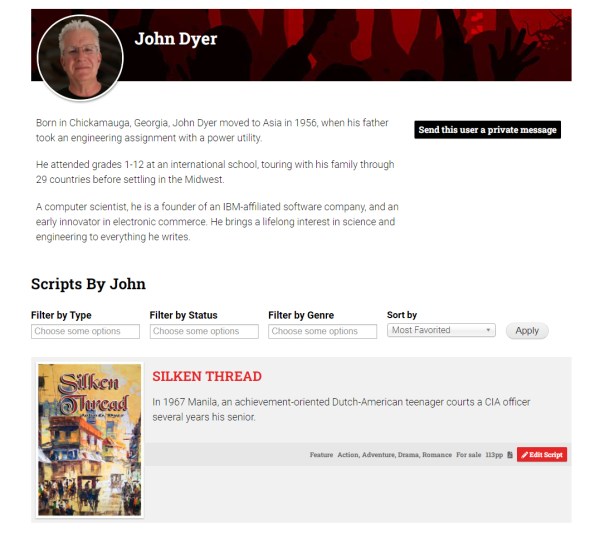
Earlier this year, I submitted my first-ever attempt at writing a screenplay to a smallish indie filmmaker, arranged through a service provided by Stage32. A producer had issued a call for coming-of-age stories, and my novel Silken Thread kind of fits. In 1960s Manila, an American teenager courts a CIA officer several years his senior. Novel here, screenplay here, if you’re curious.

Spoiler alert — I was not offered a movie deal.

I was told I’d written a novel but not a screenplay. Also …

  • The story is missing the exciting parts of the protagonist’s life until the last 20 pages (during which the hero almost dies).
  • The narrative structure should adhere to the three-act form.
  • The author should pay attention to story beats.
  • There’s not enough drama.
  • The author should ask the question, “Why would anyone want to watch this?”
  • The hero David Aarens is a person who never says ‘no’ to the challenges in his life.
  • The document layout does not “look like a professional screenplay” and I should use Final Draft as an authoring tool.
Continue reading “Played out — John Dyer Writes”

Post-Vellum Euphoria

My novel Elbert was at 96,000 words, final chapters unsettled, manuscript no longer consistent with the outline. So, I went back to the beginning — in the expectation that a better understanding of where I started would suggest how the story should end.

After four laborious rewrites of the book’s opening act, the text was hitting 100,000 words, a surprise since I thought I was streamlining it. The good news — I know what I’m dealing with. Yesterday, I wrote:

“Elbert is a story about relationships, self-discovery, and the necessity of facing the future with courage and compassion.”
Continue reading “Post-Vellum Euphoria”

Elbert is LIVE on Kindle Vella

The first 3 chapters are free! Act 1 is complete and edited. I'm sitting on the edge of my seat waiting for readers, so jump on out there!

In 1928 South Dakota, a retired country physician is made privy to Earth’s secret history and much, much more. There’s life on other planets, a family he didn’t know about, he’s getting younger, not older. Eighty-three years old, made stoic in attendance to the suffering of others, Doctor Elbert Holland Harrison thought he was waiting to die.

Now he’s waiting to live.

Elbert is a story about relationships, self-discovery, and the necessity of facing the future with courage and compassion.

Captain Hook, or not?

I’m still considering the option of advance publishing Elbert on Kindle Vella. Now, after four editing passes over part one, the master arc is firmly defined, so it’s not much of a risk delivery-wise … but, the question arises as to whether it’s good enough that I won’t be embarrassed for having done it. Also, I can’t tell if I have a hook in the opening act.

What say ye – would you spend another 8 cents to read the second chapter?

Part 1 – Chapter 1

August 16, 1928 — The Lazy L Ranch, South Dakota

“Well, ain’t you a furry bunch of critters.” The trail guide, a human citizen of Jivada, shook hands all around, the picture-perfect American cowboy in chaps and Colt Peacemaker — expert at rounding up Anye tourists or whatever. “Now, in these parts, the natives might call you Sasquatch, Bigfoot or Wendigo — ‘cause they’ve seen you plenty, but don’t know what you are.”

Watching from the front porch of the lodge, nursing her first cup of coffee, Francine anticipated the punchline. And they’re not going to find out today, are they?

Continue reading “Captain Hook, or not?”

Shameless expeditionism

So, some of you might have read the previous post, in which the author was indiscreet. No worries; I came to my senses and …

Wait! No, I didn’t, because I promised to reveal what I did about my writing dilemma. I brought the inciting event forward to the first chapter, along with essential preliminaries, and I think that’s going to work. See if you agree.

Continue reading “Shameless expeditionism”

What comes before ‘beta reader’? That’s what I need.

Those who’ve been reading these posts possibly know I have a SciFi novel in progress, about a country doctor in 1928 South Dakota who, among other things, meets a furry lady from another planet. You may also know that Amazon’s entry into the episodic fiction delivery business, Kindle Vella, is about to debut. Think ‘Radish’, with mega market penetration, or at least that’s what we’re given to believe.

Elbert, at 94,000 words, the ending yet to be written, might be good candidate to throw into the melee IF I can edit the first few chapters into ‘That’s right, folks … don’t touch that dial’ territory. I’m not worried about the rest of the book … there’s plenty of stuff going on after the first 30 pages, but I’m now on the 4th rewrite of the opening sonata and it’s getting hard for me to tell how I’m doing with it.

So, I show my wife version #3, and she says, “You need pirates swinging cutlasses” and I say, “It’s not that kind of story”, but I agree the book deserves something better than what I’ve written so far.

Yesterday, my brother said I need to smack the reader in the face with the core concept, right out of the gate, and I said, “That calls for a data dump, a cardinal sin that will get my tail roasted in author circles.”

But I’m going to try it anyway, on you. Call to action here – after reading Chapter 1, will you spend the tokens to get a look at Chapter 2? I would be grateful if, having taken the time to read these words, you’ll invest a little more to leave a comment. Here we go …

Continue reading “What comes before ‘beta reader’? That’s what I need.”

My homework assignment

I attended a Bryan Cohen webinar last night, on the topic of how to write book descriptions, wherein I was told that the blurb should consist of three parts, to paraphrase …

  • A telling of the protagonist’s emotional journey before the inciting event.
  • A description of bad things that could happen.
  • A closing sentence that lures prospective customers into pushing the ‘buy’ button.

In less than 150 words.

It was worth the hour-and-a-half, and not to steal from good ‘ol Bryan, but he also said one should make sure that cover, title and description are consistent with genre, so the audience can tell at a glance if the book fits with their reading habits.

Continue reading “My homework assignment”

Blog at WordPress.com.

Up ↑