From the website of author J.G. Follansbee …

Your reviews of my books help me reach my writing goals.
Fifty book reviews. That’s my ask in a competitive indie world.
Books Worth Reading

From the website of author J.G. Follansbee …
Your reviews of my books help me reach my writing goals.
Fifty book reviews. That’s my ask in a competitive indie world.
Elbert is currently in first edit at 94,000 words. How's the blurb looking?
In 1928 South Dakota, a furry citizen of another planet enlists the aid of a human physician to ensure her soon-to-be-born son will someday be able to claim American citizenship. For Doctor Elbert Holland Harrison, the event sheds light on the real story behind legendary Gods, a family he didn’t know he had, a cure for old age, an opportunity for a new life.
But the Great Depression looms on the horizon, with the Dust Bowl catastrophe close on its heels — a one-two punch threatening an alien commerce empire that feeds two-thirds of Jivada’s population, its collapse potentially leading to an invasion of Earth.
And Elbert is about to find himself in the middle of it.

A notice at Cathy’s Comps and Calls motivated me to apply at the Speculative Literature Foundation (Motto: “We’re as surprised as you are.”) for the 2021 SLF Older Writers Grant – which, being substantially over 50 and arguably a writer, I was pleased to hear about. It was a good reason to revisit my biography spiel and hone the blurb for Elbert, appended below as evidence of willingness to self-promote. Today’s featured image is the source for Paul Trif’s portrayal of Elbert Harrison on the book cover. Yes, I was a little younger then, and my hair was not black.
Born February 16, 1950 in Chickamauga, Georgia, I moved to the Philippines in 1956 when my stepfather took an engineering assignment with a power utility. I attended grades 1-12 at an international school and, in 1968, returned to the United States for college. A computer scientist, I’m a founder of an IBM-affiliated software company.
An avid reader of science fiction since age eleven, I’ve brought a lifelong interest in engineering and technology to three SF novels and an adventure/love story — The Illusion of Gravity, Quantum Soul, Resilient and Silken Thread, on Amazon, bearing common themes that, a) success flows from constructive choices, b) nobility is demonstrated through courage, compassion and sacrifice, and c) whatever one wants, he must show up to get it — to wit, life’s lessons, self-evident but worth reciting.
Continue reading “Synopsitized for your protection”Another teaser from Elbert, in which the lady meets a fellow with large teeth. The featured image is a second pass at the cover illustration by Paul Trif at Twin Art Design.
The rented aircar arrived early, giving time for the three of them to dawdle while hashing out a plan. Doctor Falun ran out to the island off Mexico where his fellow space yacht owners tended to congregate, but nobody was there. It took two minutes to go the distance, which Elbert found astonishing. “But it’s not faster than light?”
Falun shook his head. “In theory, the vessel stands still for an instant and the universe moves around it.” He returned Elbert’s gaze without blinking. “I’m not kidding; that’s what they think.”
Tom got his pants wet walking in the surf. Everyone tracked sand into the car. Falun produced a hip flask of single-malt scotch; Elbert took a capful before realizing Charlotte might think he was drunk, then had another because it was too late to take it back.
Continue reading “Disclosure”
While making up my mind what to write at the end of Elbert, now at 92,000 words, I've returned to the first chapters, intent on bringing the inciting event closer to the front. This is my first pass; a serving suggestion, if you will. Do you understand the setting? Let me know in the comments. The feature image is a first draft cover treatment. Francine, at the left, is overdue for a visit at the beauty parlor. Watch for a change in that spot.
One morning, in the wee hours before sunrise, Doctor Elbert Holland Harrison dreamed he met a lady Sasquatch — neither abominable, nor a fugitive from snowy climes, foxlike in appearance, having lovely hips and a full bosom.
He woke with her name on his lips, although he couldn’t quite speak it — the strangeness of it troubling him all day.
Francine was tired, her feet hurt, the past week of pregnancy hadn’t been agreeing with her, and it was the fourth time since breakfast that a guest asked what the ‘L’ stood for. “Lemur, as in The Lazy Lemur Ranch.”
The customer was a human from Jivada — Loka AjJivadi — probably descended from South Asians admitted into the Anye interstellar community 12,000 years in the past, thereby rescued from an existential threat she’d soon hear about if not careful. “We tell the locals it means lumberjack.”
Continue reading “A new beginning …”
Another first-draft teaser from Elbert, posted because it was fun to write.
If Slim’s grandparents were wealthy, one wouldn’t know it from their house — a modest bungalow three blocks off the bay. Their space yacht hovered in the front yard, larger than anything in the neighborhood, patio deck extended below the main entry, awning deployed, aft ramp down and a sub-compact aircar parked halfway out of the garage bay — the latter a feature Charlotte hadn’t expected to see in a boat under 30 meters.
But the 23 Mirage had a wider beam than a 19 Townhouse, yielding enough interior volume to offset the garage bay, and then some. The top deck floor plan was familiar — command compartment in the bow, then airlock, master suite, master bath, triage locker, slow-time cabinet, spacesuit locker, airlock, and storage compartment.
Continue reading “Fun to write”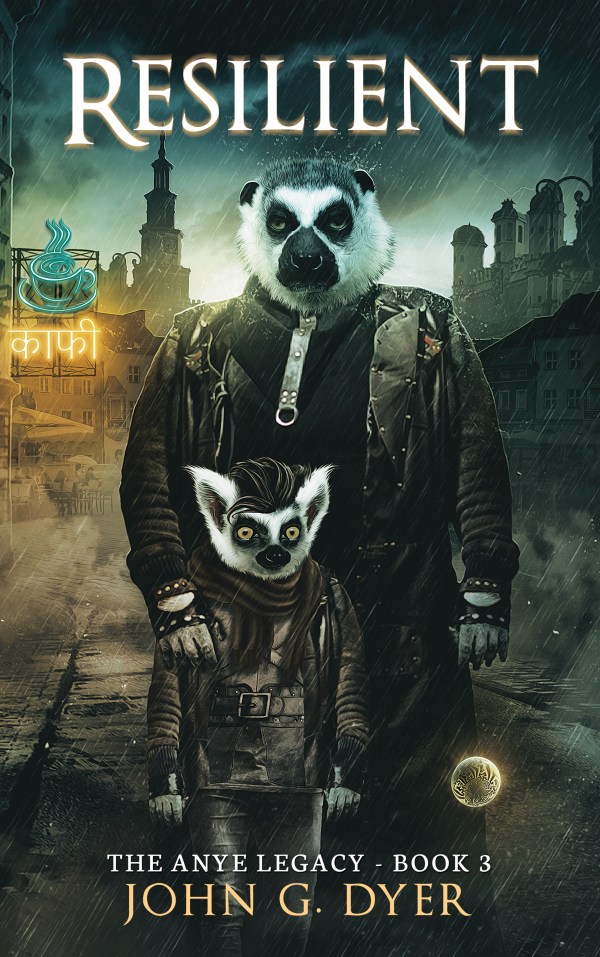
And it’s as though I’m holding 54 lottery tickets, each with a non-specific settlement date. Will anyone read the book? Will there be reviews? What will they say?
To make matters worse, I read a couple of chapters after submitting the promotion. It’s been 3 years since publication, and damned if I shouldn’t have put the inciting event closer to the first chapter. Not that I’m embarrassed; I’m still proud of what I did.
Until this week, Resilient had reached maybe 6 readers. Now, I guess, we’re going to find out about market acceptance. Did you order the book? Have you started reading yet? Comments invited!

In a video essay entitled The Nightmare Artist, YouTube creator In Praise of Shadows tells us about Zdzislaw Beksinski, an artist who emerged from the horrors of WWII Poland to produce a collection of stark, gloomy paintings. Beksinski never titled his works nor would he consent to explain himself except to say things like, “Meaning is meaningless to me” and “Interpretation is imposed by others”. Of course, that didn’t stop critics from saying what he was about, but I think he was smart to be silent. Certainly, if he’d said — about any one thing he did — “This is how I felt when the Jews were taken away”, then everything he produced would have been defined by the statement.
Continue reading “The Art of Not Explaining Art — John Dyer Writes”
Starting tomorrow, on my birthday (I’ll be 71), the eBook edition of my novel Resilient will be free to download for 5 days.
Woo!

I attended a webinar yesterday on the topic of writing better book descriptions.
In 1966 Manila, an American teenager courts a CIA recruit, 12 years his senior. It’s a mismatch, a scandal — a minefield at the crossroads of Paradise and the war in Vietnam. When she ships out, it’s over.
Or maybe it isn’t.
 John Dyer Writes
Recent Comments