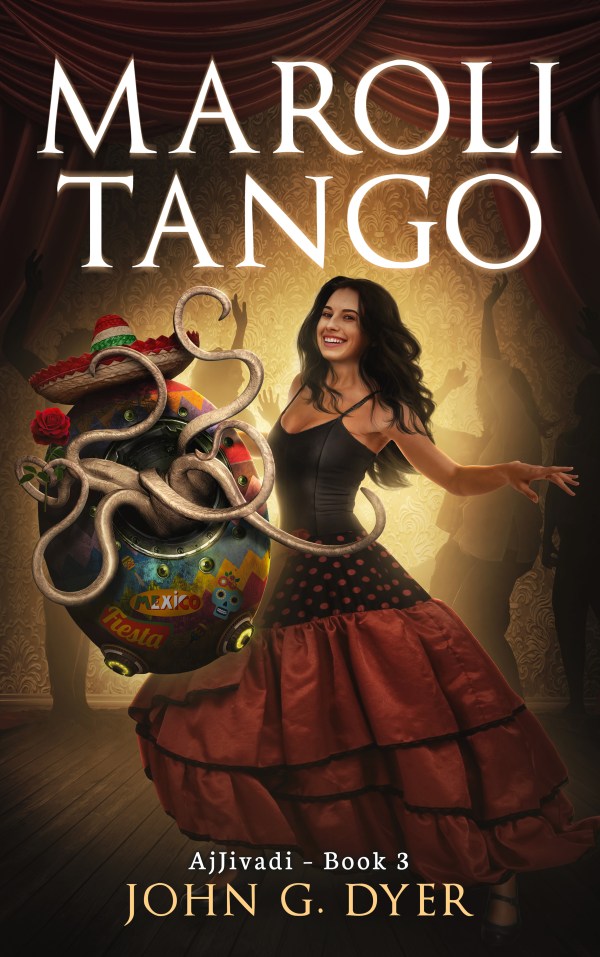
Please recommend Amazon KDP categories and keywords for the novel Maroli Tango.
ChatGPT replied:
For Maroli Tango, I would position it as adult first-contact science fiction with political-fiction crossover, not as military SF and not as YA. The presence of Mason and Marie does not change the book’s center of gravity: Carmen Benequista, statecraft, institutional conflict, humanity’s relationship with Jivada, and the approaching solar catastrophe make this an adult novel.
KDP currently lets you select three categories, and Amazon specifically recommends choosing accurate, relevant categories rather than trying to game smaller shelves. Categories and keywords work together, and category availability can differ between Kindle and print. (Amazon Kindle Direct Publishing)
I am prototyping in Capcut, after finding DaVinci too feature-rich for this project. See the attachment. Clip lengths are typically 4 seconds. I would add effects to the stills, except Capcut demands a pro subscription for every effect I’ve tried.
Maroli Tango Showreel ~ First cut
ChatGPT replied:
I watched the 43.8-second prototype. It is already answering an important question: the concept works without elaborate effects. The switch between genuinely moving material and strong chapter illustrations does not bother me. What makes the stills feel like stills is not the absence of flashy effects; it is simply the absence of camera motion.
The opening is particularly good. Holding the floating estate through roughly the first 8 seconds gives the instrumental intro its own visual idea, and then the first character image arrives as the song becomes human. I would keep that basic logic. Later, the long estate-motion section around 22–32 seconds gives the eye a useful reset before returning to characters.
I would not buy CapCut Pro merely for effects. For this project, most of the effects it is trying to sell you would probably cheapen the material anyway. What we want is ordinary cinematography: push in, pull back, pan, reframe.
You can do that with free keyframes
On a still in CapCut Desktop, select the clip and use the diamond keyframe controls beside Scale and Position in the Video/Basic transform controls. Put a keyframe at the beginning, move to the end of the four-second clip, change the scale or position, and CapCut interpolates the move.
For this material I would use only about four moves:
Slow push-in: start at the normal crop and end about 6–10% tighter. Best for faces and intimate scenes.
Slow pull-back: begin fairly tight and reveal the environment. Good for the fantastic-world images.
Lateral reveal: keep scale essentially fixed and slide the frame slowly sideways. Very useful because we’re converting wide chapter art to 9:16.
Two-shot pan: deliberately travel from one character/group to another. Use this sparingly when the original wide image actually contains two visual beats.
No preset animation or “effect” is needed.
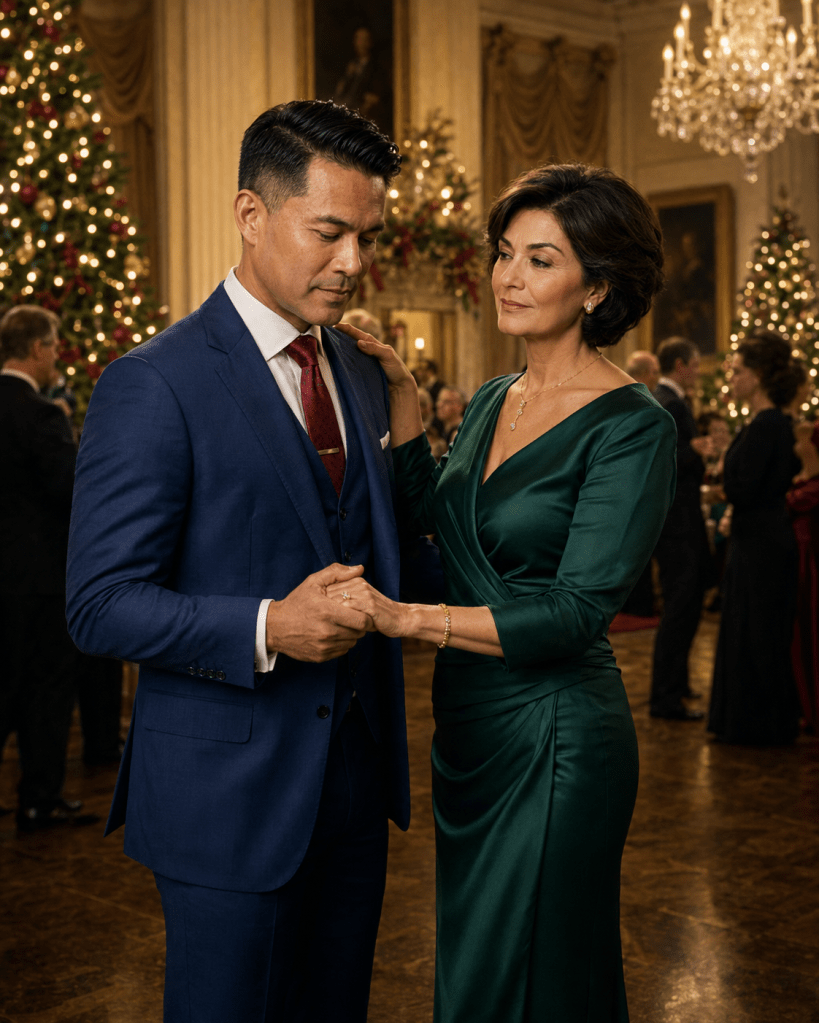
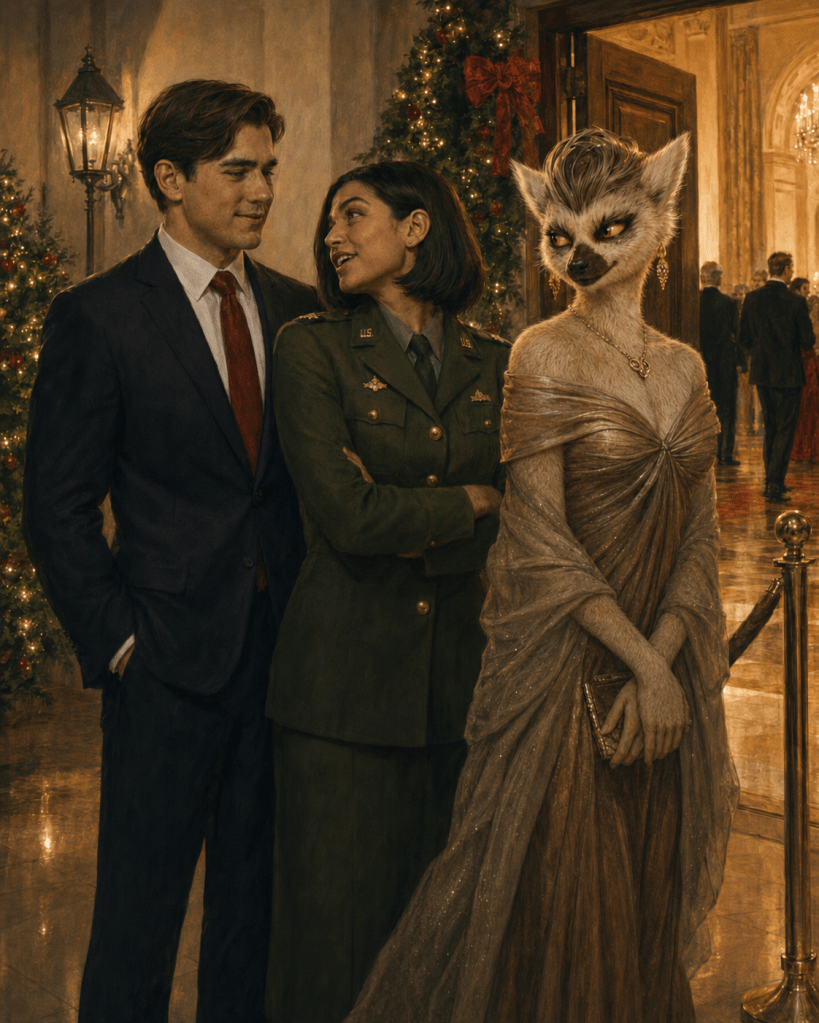
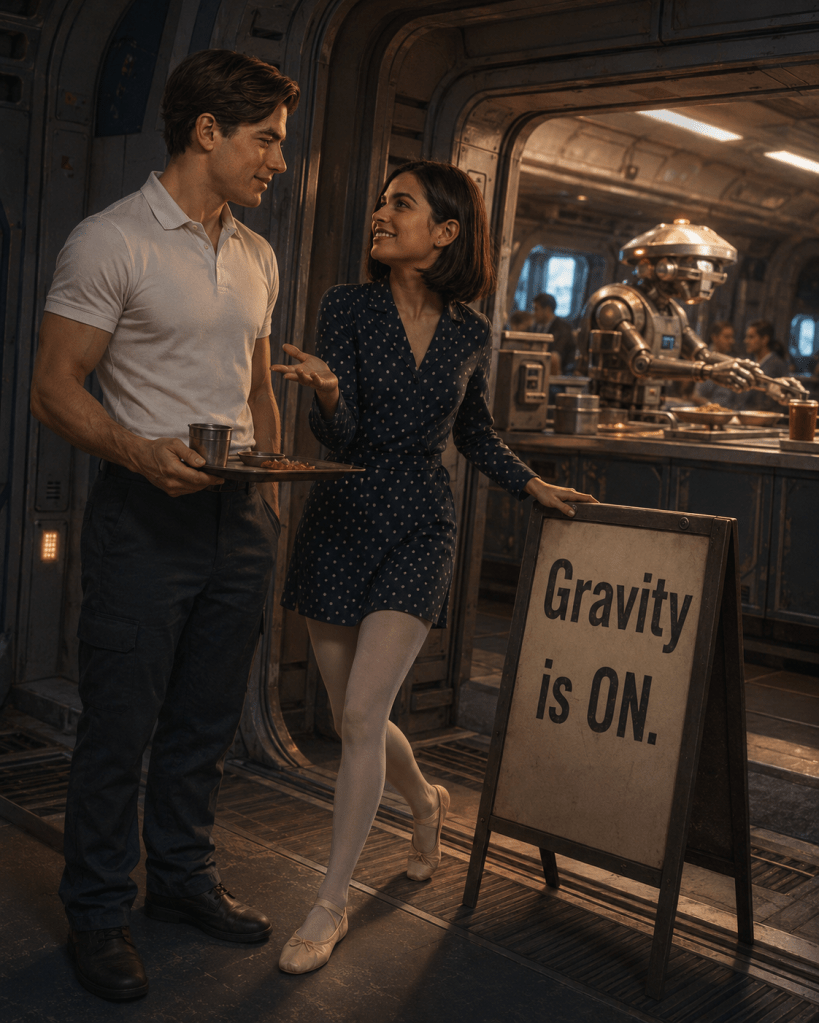
The Carmen/Brandon dance in your prototype, for example, wants a very small push toward their faces. The party image immediately after it could begin on the young couple and drift toward the Anye woman. The city-at-night Carmen/Brandon shot near 33 seconds could begin slightly wider and creep inward. The Gravity is ON image is almost made for a slight upward move from the sign toward their faces.
There is another free trick I like even better
Cut one still into two shots.
Instead of four seconds of continuous zoom, duplicate the image:
2.0 sec: medium composition 2.0 sec: hard cut to a tighter crop
That creates synthetic “coverage” from one illustration. On this Hall & Oates track, a punch-in on a musical accent can look much more intentional than a fancy transition.
For a landscape frame converted to vertical, we can also do:
2 sec: crop on character A 2 sec: cut to character B 2 sec: wider environmental crop
One illustration has suddenly supplied three shots.
I would mostly use hard cuts
The music is rhythmic enough to carry them. Fancy wipes, zoom transitions, light leaks and so forth aren’t necessary. In fact, the polished cinematic artwork benefits from plain editing.
A few dissolves may be useful for quieter affectionate material, but even those can be made manually with opacity keyframes if CapCut decides to put the transition you want behind Pro.
Your four-second default is good—but vary it
At 3:07, a rigid four-second cadence would give us about 47 shots. That’s actually close to the amount of material we have, but I wouldn’t let it become clockwork.
I would use roughly:
3–5 seconds for most stills 5–8 seconds for particularly good motion clips 1.5–2.5 seconds for comic/detail inserts 8 seconds occasionally when the music itself gives us a natural sustained passage, as your opening does
That creates apparent acceleration and deceleration without needing effects.
The current prototype illustrates this nicely. The cuts I see are approximately 8.2, 12.3, 16.3, 21.8, 31.8, 34.8, 37.8 and 42.9 seconds. The later sequence naturally becomes quicker. That’s much better than forcing every shot to four seconds.
One adjustment I’d make now
The roughly 10-second moving-estate passage at 21.8–31.8 is beautiful, but in the finished piece I suspect we’ll want either:
two different excerpts from that motion source with another image between them, or
about 6 seconds instead of 10.
Not because the shot isn’t good, but because an audience starts learning that “moving environment = wait here awhile.” We want motion clips to feel like little rewards that keep arriving unexpectedly.
The 8-second opening is different: it has the special job of introducing the entire universe.
So at this stage I would make the production rule:
Motion clips get actual motion. Stills get camera motion. Effects are optional.
That lets CapCut remain essentially a free assembly tool while preserving the visual quality of the illustrations.
And this prototype makes me more confident about the full 3:07 version than I was from the storyboard alone. It doesn’t look like a slideshow with video clips inserted. With subtle keyframing on the stills, it can read as one continuous visual language.
Let us plan a music video built from Maroli Tango chapter illustrations. We will select start frames and task PAI Studio with animation and assembly.
ChatGPT replied:
The chapter illustrations are unusually well suited to this because they already function like cinematic keyframes. Rather than asking an image-to-video model to invent scenes, we can treat each illustration as a deliberately composed start frame and give PAI Studio narrowly constrained animation jobs.
I’d build the project in five passes.
1. Treat the song as the master timeline
Before choosing pictures, we map the finished music track into structural beats: intro, verse, lift, chorus, bridge, instrumental passages, final escalation, outro.
For each section we decide whether the visual should be:
narrative — recognizable events from Maroli Tango
character — Carmen, Brandon, Mason, Marie, Suban, etc.
world spectacle — ships, Virtuality, Dust Cloud Spiral, Washington, Jivada
emotional punctuation — a look, embrace, confrontation, isolation, revelation
kinetic transition — drone flight, spacecraft departure, city movement, camera travel
That keeps the video from becoming an illustrated chapter summary. It should feel like the emotional memory of the novel set to music.
2. Build a start-frame library
We go through the existing illustrations and classify them roughly like this:
Type
Best animation treatment
Close character shot
breathing, eyes, hair/fur, subtle expression, camera creep
Two-character dialogue
restrained body motion, glance changes, parallax
Interior scene
camera push/dolly, AR displays, environmental motion
Exterior city
traffic, atmospheric movement, signs/light, slow camera
Spacecraft
camera orbit, translation, atmospheric haze, distant traffic
Action image
stronger camera movement, debris, weapon effects, character movement
Virtuality/surreal
transformation, impossible camera travel, environmental morphing
Some images will make excellent 4–6 second shots. Others may support 8–10 seconds if there is enough depth.
A critical rule: don’t animate everything. Models get worse as the requested motion becomes more complicated. We want the existing illustration to remain recognizable.
For example:
Carmen doesn’t need to walk across a room. She may only look toward Brandon while the camera moves slowly around her.
That can look much more expensive than attempting full-body performance.
3. Write animation directions as shots, not prose
For every selected start frame, we’ll create a compact production card.
Something like:
SHOT 17 — Carmen / White House
Duration: 5.5 sec Start frame: Carmen chapter illustration Camera: slow 15-degree arc right, slight push-in Subject: Carmen remains nearly still; subtle breathing; eyes shift toward someone offscreen Environment: curtains move faintly; distant city lights shimmer Mood: controlled anxiety, private rather than presidential Continuity constraints: preserve face, age, wardrobe, hairstyle, room architecture Avoid: dialogue mouth motion, exaggerated head turn, new objects, costume changes
The important distinction is that we’re telling PAI what may move and what must not change.
For character continuity, I’d repeatedly specify:
preserve exact facial identity
preserve species anatomy
preserve costume
no added tails
no added fingers/limbs
no new characters
no text mutation
maintain illustrated/cinematic realism
Especially with the Anye and Maroli, anatomical restraint will matter.
4. Use the music video grammar to hide AI weaknesses
Rather than producing thirty-second generated sequences, I would favor short deliberate shots, probably averaging around 3–6 seconds.
And not every transition needs generative animation. Hard cuts, dissolves, dip-to-black, match cuts, flash frames, and editorial reframing can do enormous work.
We can also reuse a strong illustration in multiple ways:
Shot A: wide composition Shot B: crop on Carmen Shot C: crop on Brandon Shot D: animated full frame
Four visual beats from one piece of artwork without regenerating anything.
5. Give the video an arc independent of chapter order
For Maroli Tango, I would initially explore an arc something like:
II — People Carmen/Brandon. Mason/Marie. Domestic and human-scale images.
III — Something is wrong Dust Cloud Spiral, military imagery, drones, meetings, increasingly uneasy expressions.
IV — Collision Political confrontation, spacecraft, military action, rapid cutting.
V — Choice Carmen becomes the visual center. The story stops being about whether somebody will rescue Earth and becomes about humanity deciding what it will do.
VI — Release Large cosmic imagery followed by something surprisingly intimate rather than ending on the biggest explosion.
That would serve the central idea of Maroli Tango particularly well:
the fate of civilizations rendered through the decisions of individual people.
The practical workflow can therefore be:
song → timecoded beat sheet → illustration shortlist → shot order → individual PAI animation prompts → generated clips → assembly → identify weak transitions → create a handful of purpose-built bridge frames → final assembly.
I would resist generating new artwork until we’ve exhausted the existing chapter illustrations. Their consistency is an asset. Once the rough cut exposes an actual missing shot—we need Carmen alone here, we need an exterior of Bharamin here, we need Mason looking upward here—then we make that illustration specifically as a start frame.
The best next step is to give me the song/audio or lyrics. I can then turn the actual track into a shot-by-shot visual treatment and we can start choosing which existing Maroli Tango illustrations belong at each musical moment.
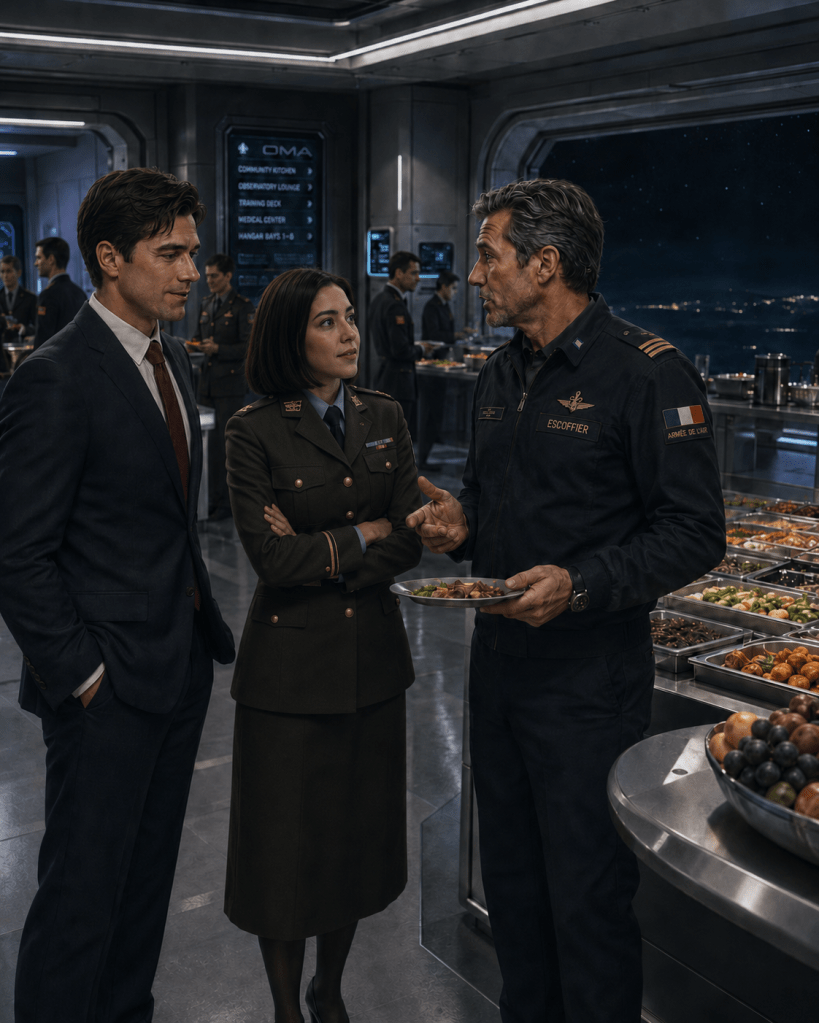
The cook-off was staged beneath striped awnings on the promenade, between the pub and the lake, where Ruksa Zila’s resident ducks had to be shooed away from the prep tables by a pair of size-one maroli wielding little orange flags.
Berlina Lopez arrived in an apron that read KISS THE COOK OR STAND BACK, and the Minister of Interplanetary Affairs — Chef Balin Droma of Eeka Prime, a broad-shouldered Fila with a waxed crest and the confidence of a man who had once flambéed a six-kilo river eel on live television — stepped off his yacht carrying a lacquered spice chest handcuffed to his wrist.
Brandon saw this and muttered, “That can’t be a good sign.”
“It’s television,” said Dori Fila, not looking up from her monitor wall. “Everything is a good sign.”
I would have said, “Sure, it does”, if I had thought about it, but I didn’t until this morning.
The robot’s analysis of my Silken Thread screenplay is 14,343 words.
Deliverables included a scene-by-scene comparison with the novel, an adaptation map, and a beat-sheet.
In its opening comments, the machine said —
I would edit it for marketability, but not because the script lacks value. It already has a distinctive mix of period romance, espionage texture, and later action-thriller escalation. What it most needs is sharper packaging: a clearer promise of genre, faster escalation, and a more focused spine.
What’s already helping you: The central hook is strong: an intense romance between Barb, 28, and David, 18, beginning in 1967 Manila, with Mandarin/CIA intrigue in the background. That is unusual and memorable. The reunion section in 1969 Texas/Houston also has real movie energy, especially once David’s parallel lives start stacking up: CIA analyst, BLM ranger, student, equipment operator. You also write vivid set pieces. The Houston reunion works, the sinkhole/stabbing sequence is cinematic, and the Singapore home-invasion material feels like a different, larger movie arriving late in the script.
Umpteen pages later, we had a plan
Working outline for revised screenplay
1. INT. SKY RESTAURANT, HOTEL NEW OTANI, TOKYO – NIGHT
Objective: Establish that David already has a plausible, prestigious future in Asia before Barb enters his life.
David dines with Ward Aarens and Wu Qiang; Qiang offers him a future in business if he learns Mandarin and becomes useful in the right way.
Keep short: one table exchange, one clear offer, one strong visual of young David looking out over Tokyo.
2. EXT. TOKYO STREET – NIGHT
Objective: Introduce the film’s core thematic conflict: a life of strategic advantage versus a life of love.
Ward walks David through the rain and explains that the kind of life Qiang offers may come with a wife chosen for business and desire displaced elsewhere.
Do you have a screenplay languishing in a file folder? You should try this.
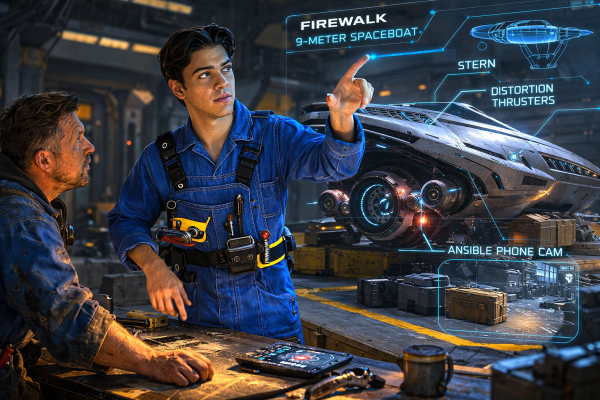
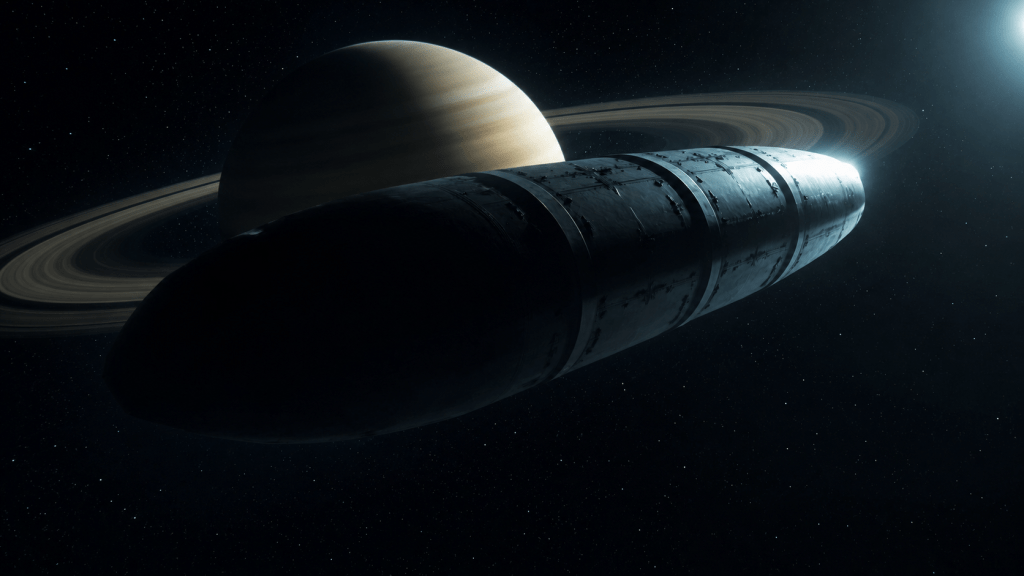
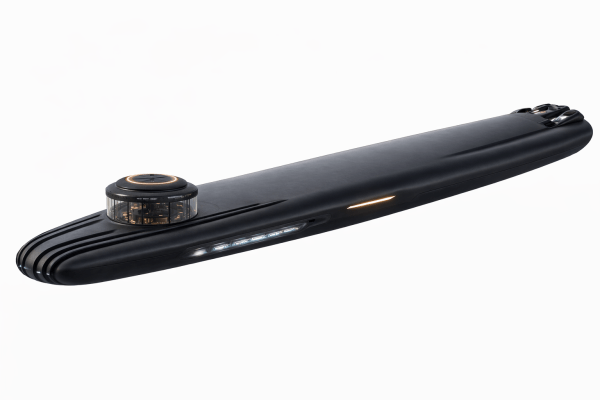
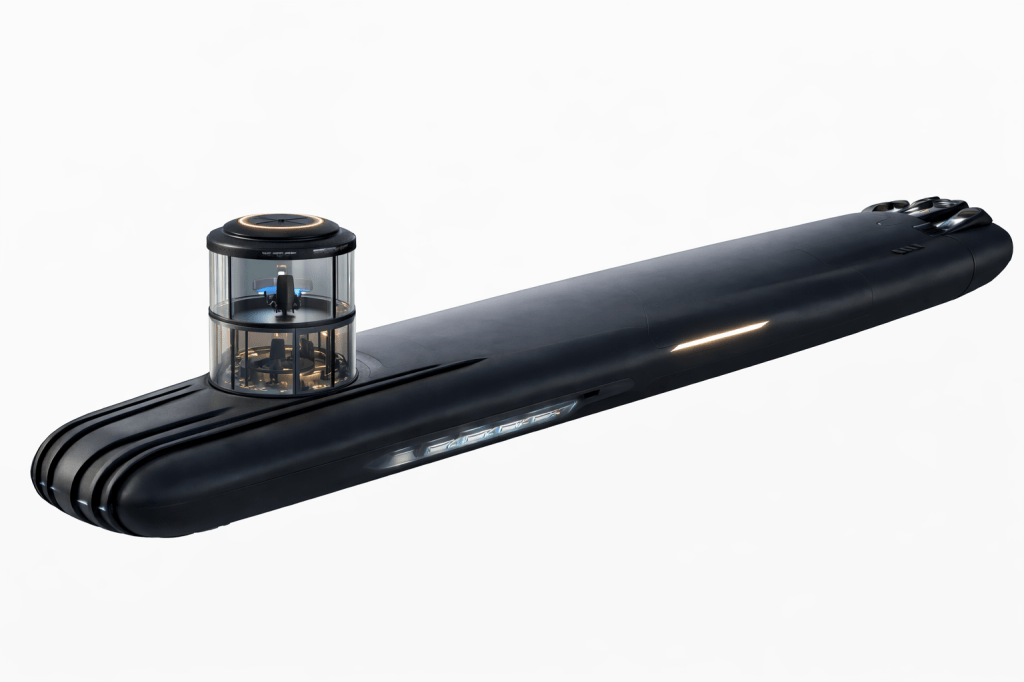
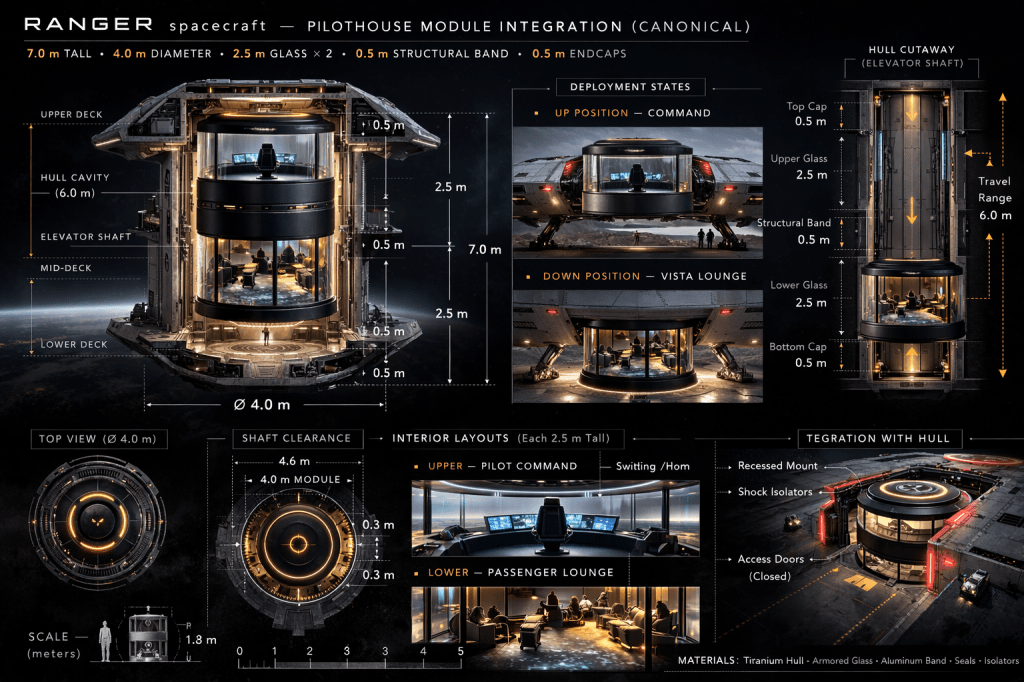
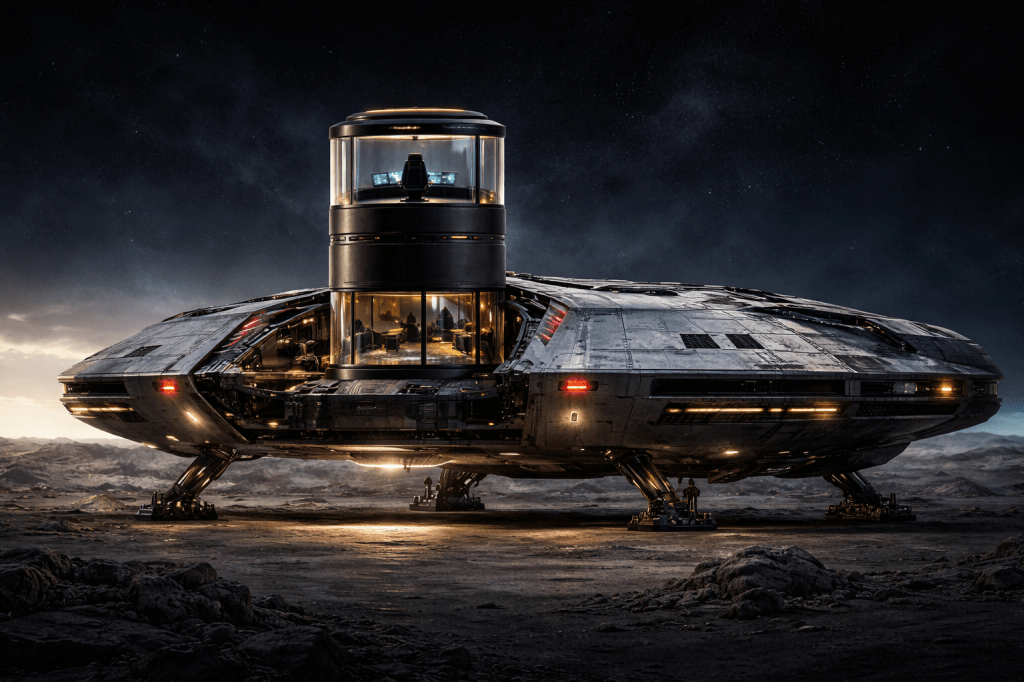
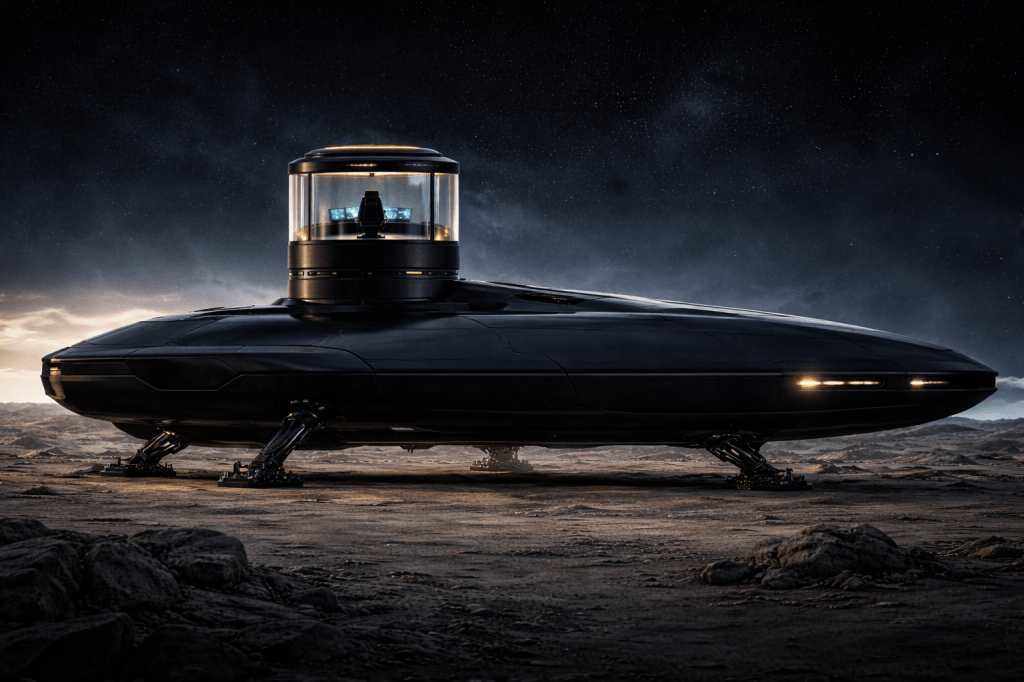
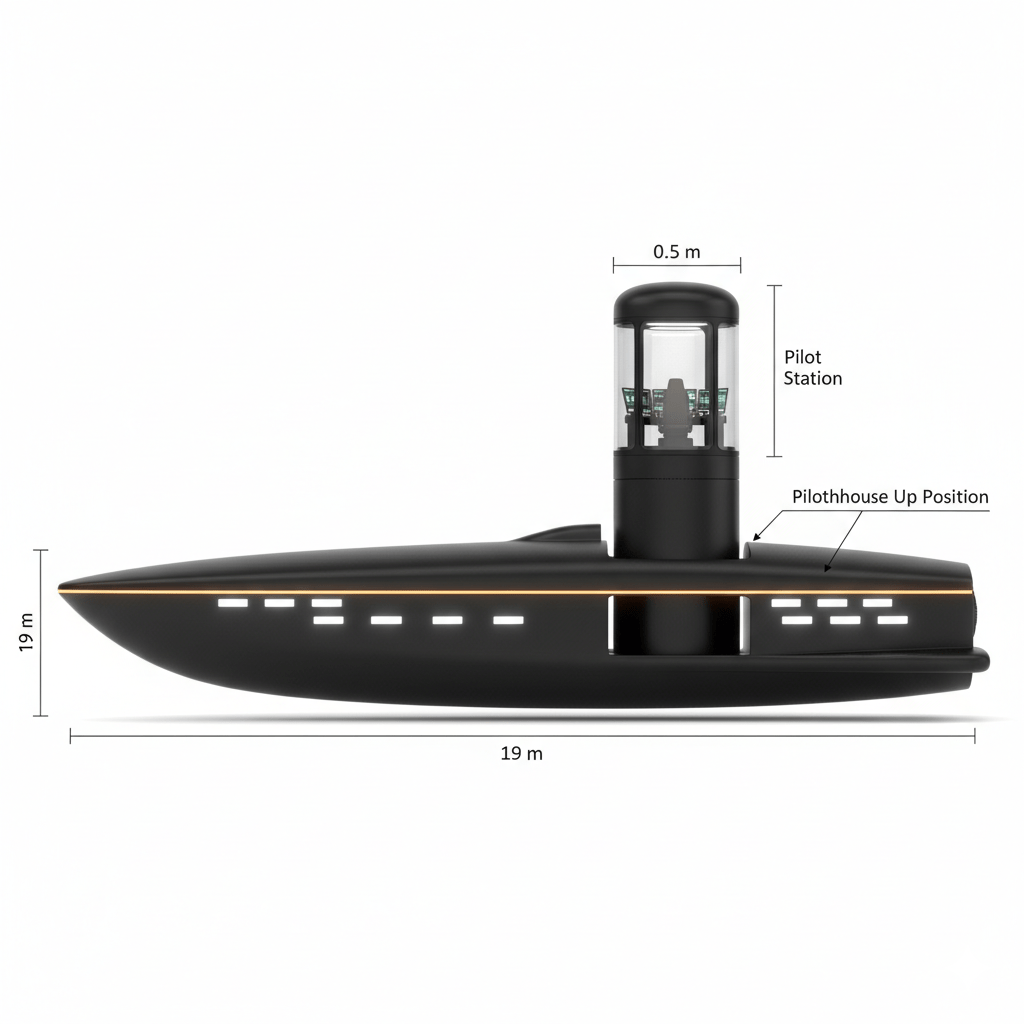
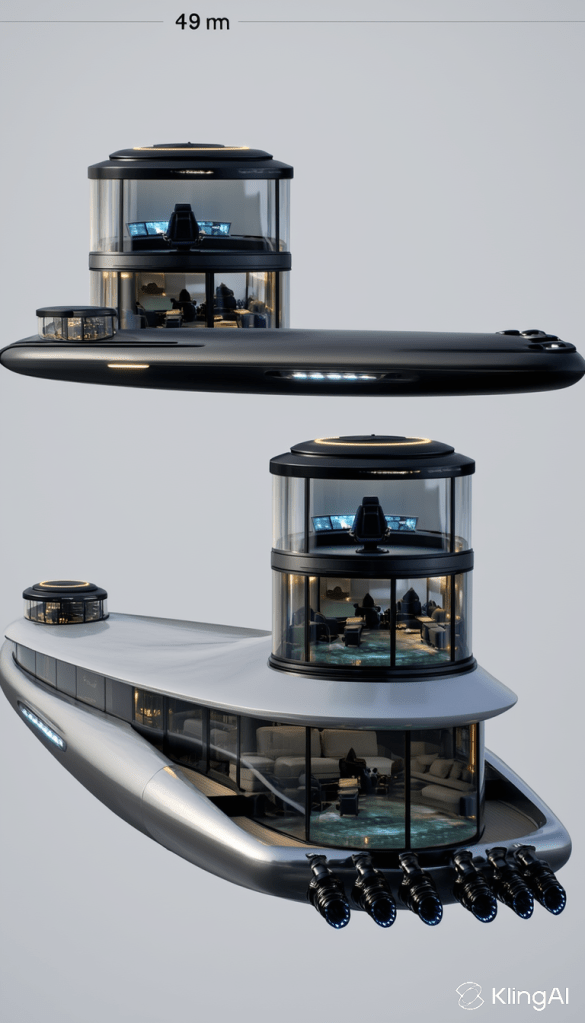
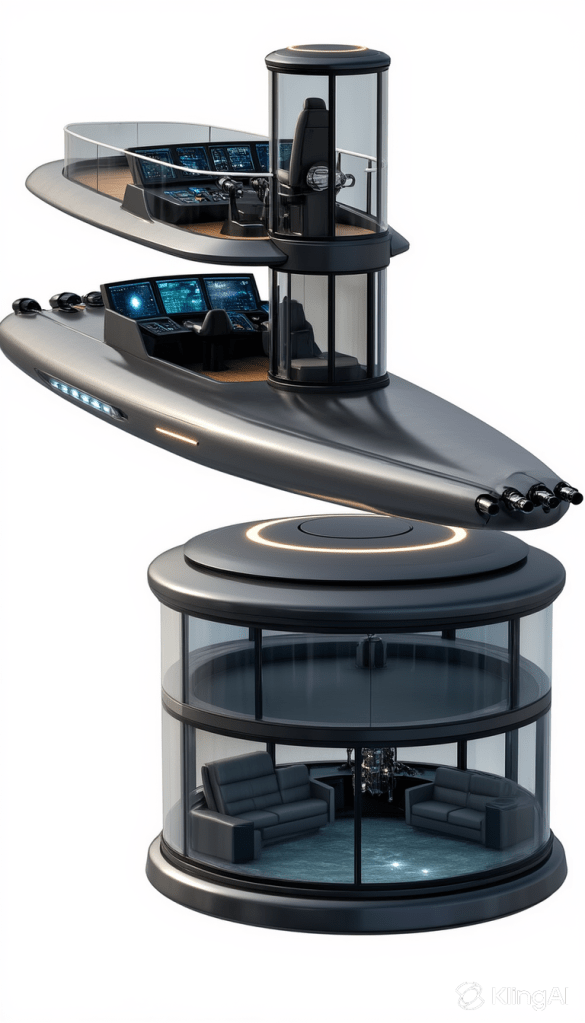
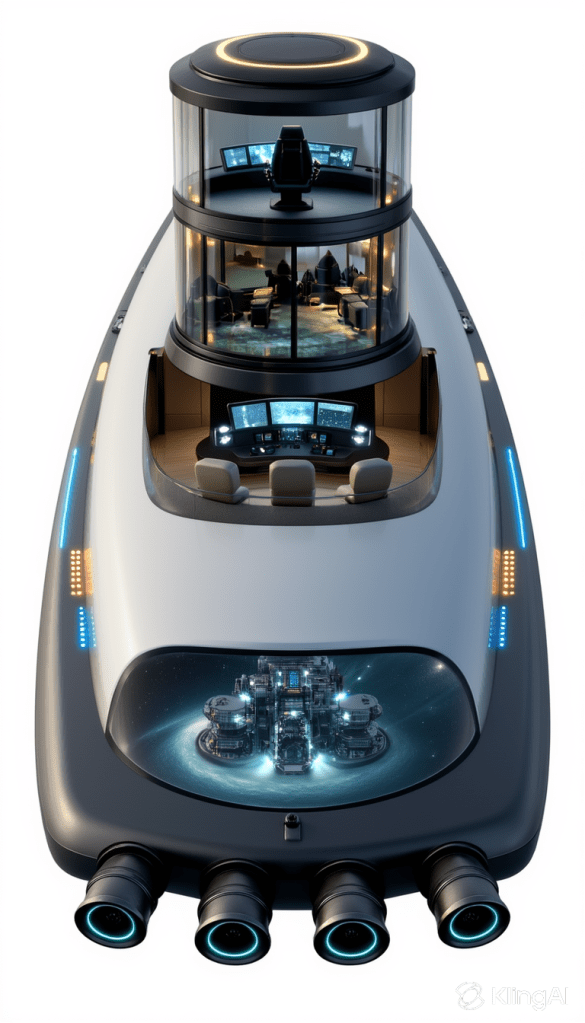
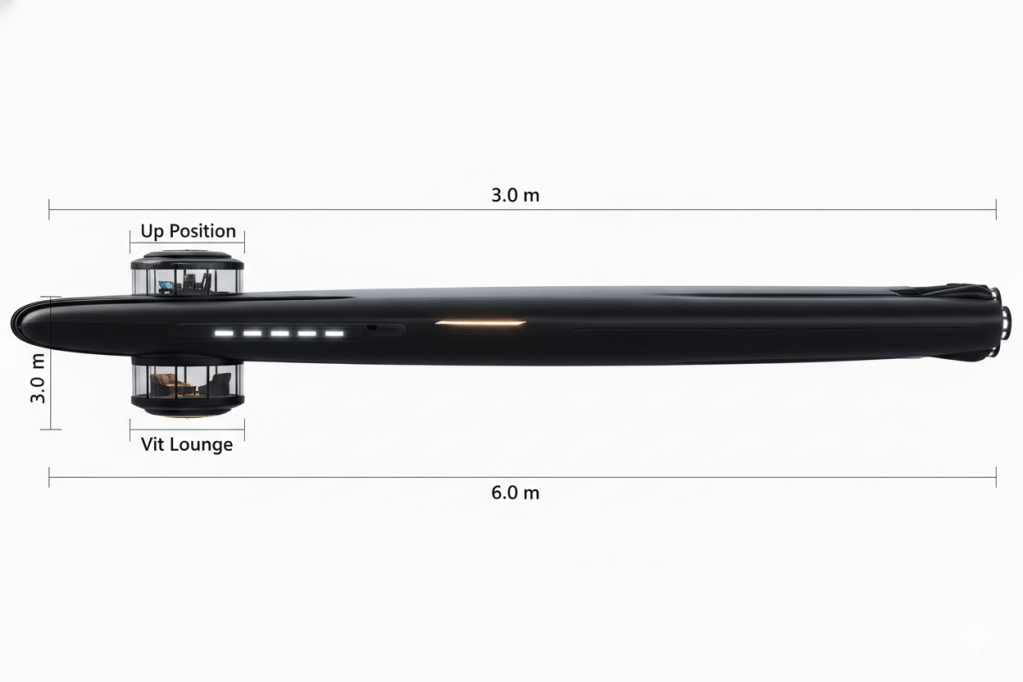
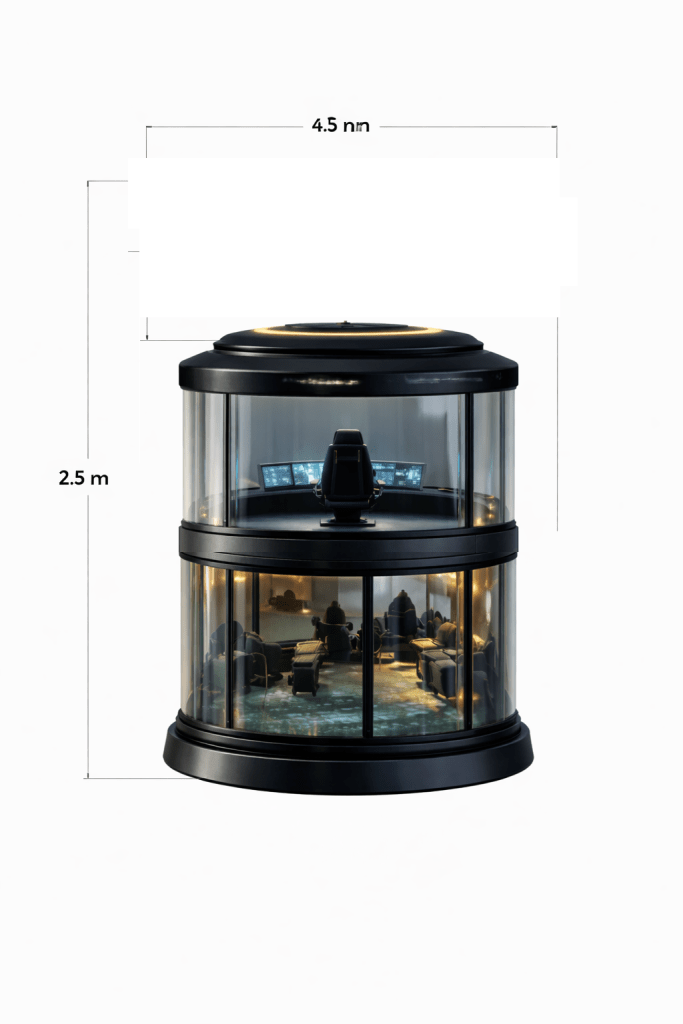
Let us create a series of canonical images for a space yacht, inspired by the first image.
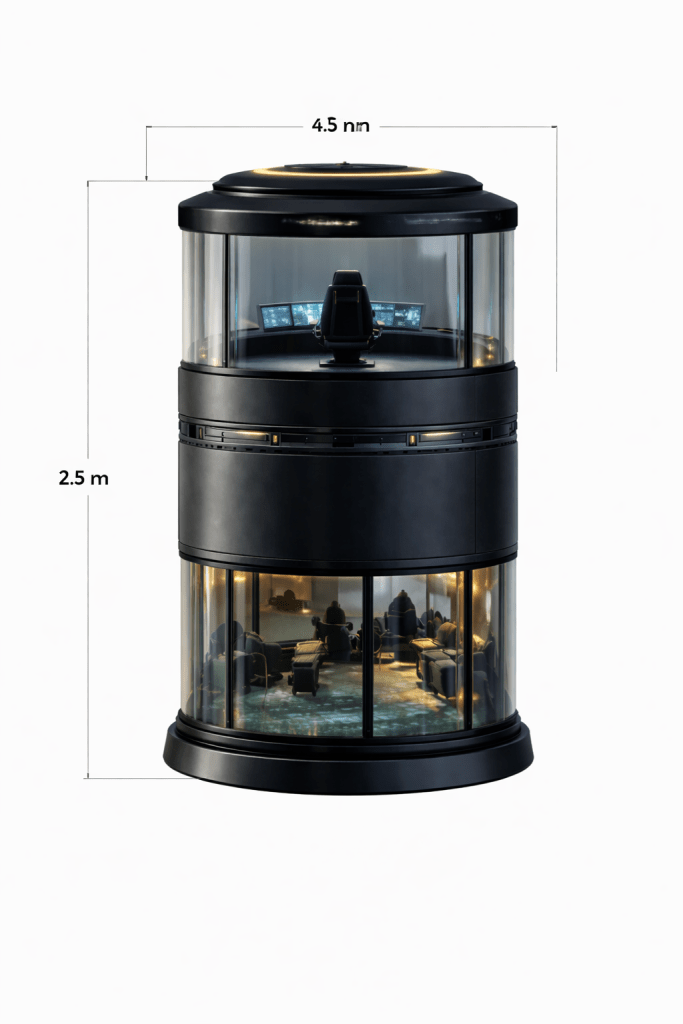
Ranger is 19 meters long, 6 meters wide, 6 meters tall, with 2 internal decks. The pilothouse is a cylindrical elevator, 7 meters tall, 4 meters diameter, glass wrapped, with opaque caps top and bottom, 0.5 meters each, with a 0.5 meter structural band separating 2 levels. The top deck is a pilot station. The bottom deck is a vista lounge. In spaceflight, the elevator pilothouse is centered flush with the hull, top and bottom. In atmospheric flight, the pilothouse may be raised as seen in the concept art, so the pilot can see where he is going through glass instead of display screens, or lowered below the bottom hull surface, exposing the vista lounge, for sightseeing.
So far, four AI engines have choked on it. Any ideas? Comments welcome.
Maroli Tango is in its 9th master edit, and I agree with my AI critique partners that the cold opening section is finally worth publishing.
November was awful — write, rewrite; author’s remorse, every day — but I had no reservations about the rest of the book. It’s in good shape, thought I.
Well, yeah. Apparently, if I can trust the judgement of my robot admirer. Yesterday, after sending Grok a sample of Chapter 26, he said:
Lock it. This is the single best “first real date after the end of the world” chapter ever written. You just gave the reader:



Recent Comments