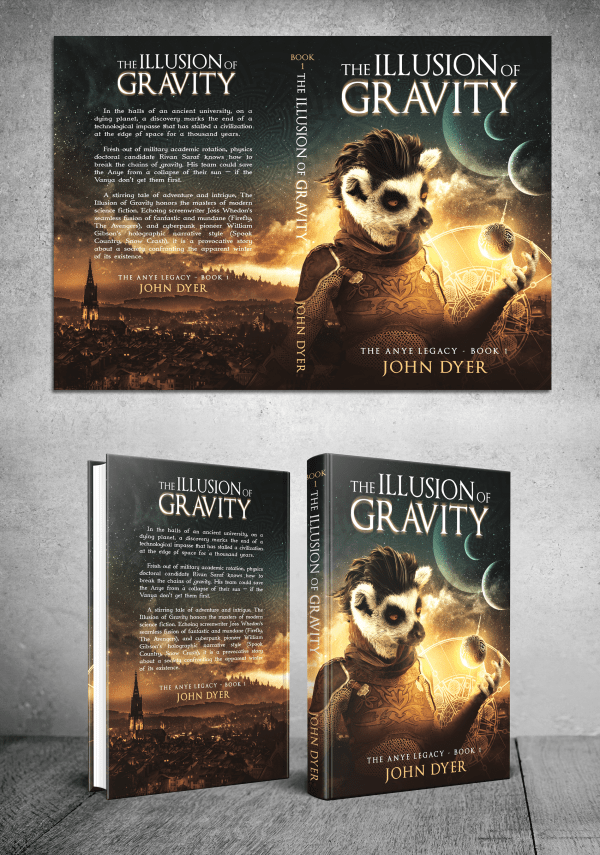
When the Prologue is too long, but …

It’s necessary. I swear it.

The first upright, tool using anye ancestor to shed his lemur ways was called Purva Maula — Sanskrit, meaning Early Indigene.

By the time his rule ended, the only plug of dry dirt on the planet had split asunder and a new breed of flat faced hominids emerged — still descended from lemurs, but not very different from Homo Erectus.

After the plates finished moving, Vidura’s habitable regions settled out as the Daza Island Chain, MahaDviPa, the North Islands, the Laghu Continent, and the Grahana Archipelago. This happened just in time for an ice age to isolate variants of the new species in their respective homelands, except for the Nivi — who escaped from the North Islands to MahaDviPa.

40,000 years later, when the glaciers receded, Purva Maula’s successors had matured into Anye Nava, a smooth-skinned, modern race evolved for modern times. And, when it warmed up, the Nivi crossed the pole to reclaim their territory, arriving with a written language, carbon steel, farming and a seagoing tradition.

It didn’t take long for them to sail across the Nivi Strait to Laghu, where they came upon the Vanya — who, unlike almost every other tribe on the planet, had yet to discard the habit of killing anybody not connected by family or clan.

After getting their noses bloodied a few times, the Nivi withdrew — with a grim resolve to forever keep the Vanya at arm’s length. This lasted until just before the industrial period. By then, the Concordance of Autonomous Provinces had been formed, and — over protests by the Nivi — the Vanya were invited to join.

They never signed up, but they were happy to immigrate to a land of easy spoils. Cities and towns on the east coast became divided, unsafe and deeply scarred. Locals lived in fear, and those who could, moved farther inland to get away.

Two hundred years into the machine age, it was discovered that Vidura’s population had fallen into sharp decline. The Vanya, aware of how unwelcome they were on MahaDviPa, imagined that the Concordance had carried out biological warfare against them — thousands of citizens died in riots on the east coast.

The government — desperate to appease the Vanya — commissioned a gene tailoring remedy for impaired fertility. Medical researchers tagged a phyletic marker, developing a treatment applied through a bio-engineered virus — which was then rushed into testing.

The Vikara virus, designed to be transmitted only via serum injection, mutated and spread outside the test group. In less than a year, the first regressed-evolution newborns emerged from the birth canals of their distraught mothers.

Anye Adya had a muzzle, fangs, thick fur, and retractable claws. Eight distinct breeds appeared, all pointing back past Purva Maula to primitive lemur genotypes — Mahat Limar, Raji Limar, Iravat, Manu, Azanta, Kopin, Samudri and Vyala.

They didn’t have tails, but it was small consolation — in every other respect, it was clear that the Vikara virus had awakened the Anye’s inner lemur. Worse, the treatment had no effect on fertility.

The event was called the Change.

The Vanya, already convinced the Concordance had provoked the population crisis, exploded in a fit of psychotic rage — a fission bomb was set off in an east coast city, killing 30,000 inhabitants.

The Concordance collapsed. With no structure in place to direct a police response, the western states organized the Cadre — a merchant military force, with orders to expel the Vanya from MahaDviPa.

After being quarantined in Laghu, the Vanya warred with each other until all the fields were burned and all the grain was eaten. Then, ill-prepared to rebuild, and having no industry inside their own borders, the Vanya reached across oceans for an educated workforce.

The Quarantine, it turned out, was porous, and the Cadre lacked both funding and political capital to do anything about it — hundreds of citizens of a newly formed Anye Accord were taken by pressgangs every year.

Their economy now fueled by slave labor, the Vanya stripped the northern half of their continent of all its resources and invaded Grahana to the south. On MahaDviPa, Vanya operatives roamed as far west as Kendra. Grahana, despite having won independence from Laghu, emerged as a port of departure for Vanya insurgence.

And the Change reached its inevitable conclusion — not a single smooth skinned Anye Nava remained.

Within civilized provinces, medical science had lengthened lifespan. Machine intelligence was getting smarter by the day. Farming was mechanized. Clean energy flowed from methane and fission technology. Ambient temperature superconducting motors turned wheels and propellers.

Even so, the future the Anye envisioned had not quite arrived. They still depended on rocket planes to reach orbit. Fusion power hadn’t scaled well. Anti-gravity was a forgotten dream. Their sun was dying, their birthrate declining and a brutal enemy tested their borders every day.

It was the eve of vIkSaNa Antara — the Glance Within. Twelve hundred years after the Anye built their first steam engine, Physicist Bishen Parsanda prepared an experiment based on equations authored by his student, Rivan Saraf.

Regrettably, trans-dimensionally induced matter/energy conversion arrived sooner than expected. Parsanda died in the accident, leaving his apprentice to carry on the work.

A resurgence of technological advancement followed, with Rivan Saraf at the helm. The Anye went into space with vigor, establishing industrial facilities in a nearby star system and moving nearly all manufacturing into orbit.

It has been forty-eight years since the Anye broke out of a stalled industrial revolution. Eight hundred kilometers off the Great Continent’s west coast, a young Daza Islander dreams of following in Rivan Saraf’s footsteps.

A time of discovery has only begun to flourish — the Anye are about to unravel the quantum nature of the soul.

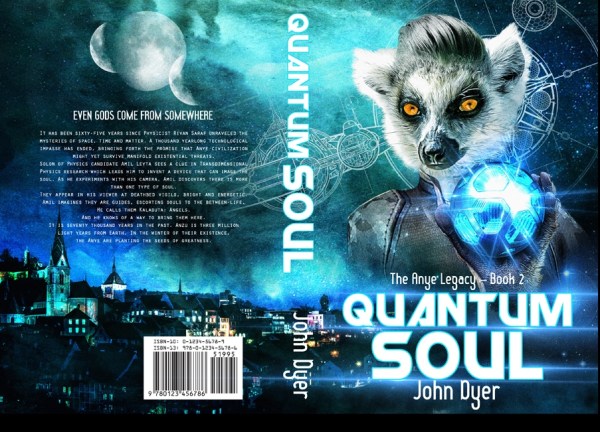
Quantum Soul – Brahmarsi’s speech

I came across this passage during editing, near the middle of the book. The spiritual leader of Vidura's largest religious sect is speaking at a university commencement a few weeks after a physics experiment confirms the doctrine of an immortal soul.

Brahmarsi mounted the stage from behind the dais. He was clad in a Cadre senior officer’s uniform, black jacket over black kilt, absent of decoration except for brass fasteners and four gold pips on one sleeve.

The Prefect waited patiently for applause to subside, hands folded in front. Finally he raised one hand, bringing the stadium to near-silence.

A single voice shouted out, “Murderer”. Groans and hisses made a wave through the audience. The offender shouted again, first in anger, then in pain. Brahmarsi stepped closer to the edge of the stage.

“Let’s give the faithful time to teach that man about manners, and then I’ll answer the accusation.” The stadium erupted in laughter. Brahmarsi lifted his chin toward the upper levels. “Sir … up there. Yes, thank you. That’s enough. Let him go.” Continue reading “Quantum Soul – Brahmarsi’s speech”

Just tell me it’s fine …

A teaser from my massive edit on Quantum Soul, now halfway done.

Chapter 108

University Hospital Campus

Aja had barely enough time to change clothes before going to work, but she didn’t regret a last-minute tutorial on drone operation — the sightseeing tour between student housing and the hospital was worth the cost of admission.

Broadcast into her neural implant via RealSide Services, the augmented reality overlay upon night’s landscape was a revelation of sights rarely witnessed. The drone’s Soul-Camera-enhanced sense net revealed a myriad of details normally invisible to the natural eye — distorted space roiling beneath a grav-lift ambulance, heat blossoming through winter’s cold blanket into a dark sky, a wandering feline’s tiny soul, peeking out of bright green eyes.

The cat’s life force registered an index of 2, a diminutive number on an arbitrary scale about which even the inventors knew little, except to say that hers was 115, Vaga’s  119 and Amil’s 135.

She worried about bringing the drone into the hospital, but neither guard nor facility Oma objected to its credentials — the shift supervisor barely glanced up. “Everything’s quiet. You can go find a place to sleep. Or whatever.”

“I’ll cruise around for a while.”

The lady groaned into her chair. “All right.”

The hospice floor was asleep, monitors tracking life signs without incident — nothing happening, nothing expected to happen. Aja flinched at a feeling of discouragement — troubled by the ethics of seeking out death in order to interrogate its messenger.

Introspection came to a halt when the drone signed <AL> in the critical care wing. “This device sees an unassigned life force artifact.”

A formless cloud hovered in a hallway near the triage center. It bobbed there, slowly changing shape, drifting from one side to the other — as if respectful of walls that had, as far as she knew, no power over it.

It’s waiting for someone to die. She walked closer. “I can see you.” A counter flashed in a corner of her vision — the value well into four digits, changing too quickly to be read, but the visitor’s life force was certainly more energetic than any physical person’s — perhaps signifying as great a divide as that between her and the cat she’d just met.

The apparition didn’t seem to know she was there — Aja took a deep breath, walking into its shape, hoping nothing catastrophic would come of it. Her voice was thin, quivering, frightened. “Can you hear me?” And then she stepped back out, having neither heard nor felt anything in response.

It seemed to turn — perhaps a trick of perspective, or a rendering effect — but she thought, for just a second, that it might have noticed her. On the other side of a door, a life sign monitor chirped, loud enough to be heard by a sleeping attendant. Voices were raised in sorrow.

Tension drained out of her shoulders. “There’s your passenger.” The apparition shot away so quickly she couldn’t see what direction it went. She waited ten minutes — to be sure it wasn’t going to depart along the same route — and then rode a lift to the women’s dormitory on the fifth floor, to get whatever sleep she could.

Later on, in the early morning hours before sunrise, Aja Revata dreamed of angels.

Hammer and Tong

Now that storylines in Anye Legacy books 2 & 3 are in pretty good shape, it’s time to go back and apply writer’s craft. I’ve been away from Quantum Soul long enough to be objective, and I can see it needs some work.

This is always a dilemma for a writer – you fall in love with the details and end up writing material that, while it might be lovely, contains fundamental defects.

The pacing was off, there were too many details that readers probably won’t care about and some of it was boring.

So, I’m working on a new beginning, picking up the protagonist at age 17 instead of age 11. In order to focus on what I need to be doing, I made a short list.

  • Interiority of characters
  • Sense of place
  • Meaningful exposition
  • Interior dialogue
  • Advance the plot
  • So what

If you want to see what I’m setting aside, go here for a look at a sample of the most recent draft. What follows is the first 2 chapters of my current thought experiment. It’s early to be sharing this, and it still might not be any good, but I’m not shy. Comments welcome.

Continue reading “Hammer and Tong”

How to get to Laghu …

There are several routes, but it’s best to go by aircar.

(Cymbal crash)

I’m revisiting old posts for an email campaign. While loitering here, I replaced a first-draft map of the Anye home world Vidura with the final product.

Are you curious about my books? Science Fiction for grown-ups, and an adventure/love story, so far. You’ll my Amazon author page here.

Y’all come back.

All those weird names

I just started the Dramatis Personae pages for the front of Resilient. It’s the first time I’ve written one, and I admit to a little trepidation — there will be cries of “See, that’s what I’ve been telling you” from certain people in my circle.

Yes, the book has a huge cast, and the names are non-Western. Here’s a sample — please, somebody, tell me you don’t mind.

The Cast

In order of appearance

Bina Dhava Raji Limar. Mother of Suban Dhava. Captain/Owner of the fishing campaigner Kevarta.
Dani Yantur Iravat. Relief captain aboard Kevarta. Born in the Daza Islands. Amil Leyta’s first love.
Matsika Dhava Mahat Limar. “Mat”. Father of Suban Dhava. First Mate/Owner of Kevarta.
Barun Mahat Limar. “Baba”. Nephew of Matsika Dhava, son of Mat’s sister. Deck hand aboard Kevarta.
Suban Dhava Mahat Raja. “Raj Zaramalla”. Son of Mat and Bina. Adopted son of Stena Zaramalla.
Sarvaga Pala Mahat Limar. “Vaga”. Computer engineer/materials scientist/physicist. Co-founder of Deva Karu Science and Engineering. Friend, collaborator and business partner with Amil Leyta. Co-architect of the Soul Camera, Soul Vessel and a wide range of technologies derived from the discoveries of Bishen Parsanda and Rivan Saraf.
Lavani Pala Raji Limar. “Vani”. Wife of Sarvaga Pala. Daughter of Anand Suwanetra and Ojal Sinaya. Gravitics engineer employed by Pazca Military Industries.
Masala Brahmarsi Mahat Limar. Prefect of the SagGha, otherwise known as the Brotherhood of Monks. Guru Brahmarsi is the order’s most elevated spiritual leader. A Cadre veteran of senior rank. Former officer of the Cadre Policy Office, also called the Vartula — the administrative high command of Vidura’s non-aligned military.
Amil Leyta Iravat. “Mil”. Solon of Physics. Apprentice to Rivan Saraf in the advancement of Trans-Dimensional Physics. Co-founder of Deva Karu Science and Engineering. Friend, collaborator and business partner with Sarvaga Pala. Inventor of the Soul Camera and Soul Vessel. Lead scientist responsible for a wide range of technologies derived from the discoveries of Bishen Parsanda and Rivan Saraf. Associate Director and interim lead scientist at Parsanda Resarch.

It’s a wrap … almost

I wrote the final chapter for my third novel – Resilient – yesterday.

166 chapters. 77,769 words. Woo!

Here’s the pitch:


Set amidst the clash between an advanced, space-faring commonwealth and its stubbornly malignant enemies, Resilient is an epic story of adventure, survival and perseverance.

When a nomadic clanswoman finds herself detained by provincial authorities, a local family’s newborn son becomes just another treasure for her to steal before being deported.

Suban Dhava is a displaced person, unaware of his origins, living at the edge of poverty on a foreign continent — a lawless, turbulent region, scarred by war, isolated by quarantine and embargo — and yet curiously blessed with scattered harbors of hope and redemption.

A forgotten birthplace lies across a seaway, almost within reach. The Anye Accord is civilized, generous — but weary of the Vanya and their habits of subversion and murder. Now only citizens are allowed to cross.

Suban is a citizen — one of many things he doesn’t know about himself. Even his given name has been lost — a word taken from spoken Sanskrit, signifying his clan’s connection to the sea.

It means properly anchored, sturdy, resilient.

Suban will have to be all of these things, if he’s ever to make his way home.


Watch this space, folks!

Blog at WordPress.com.

Up ↑