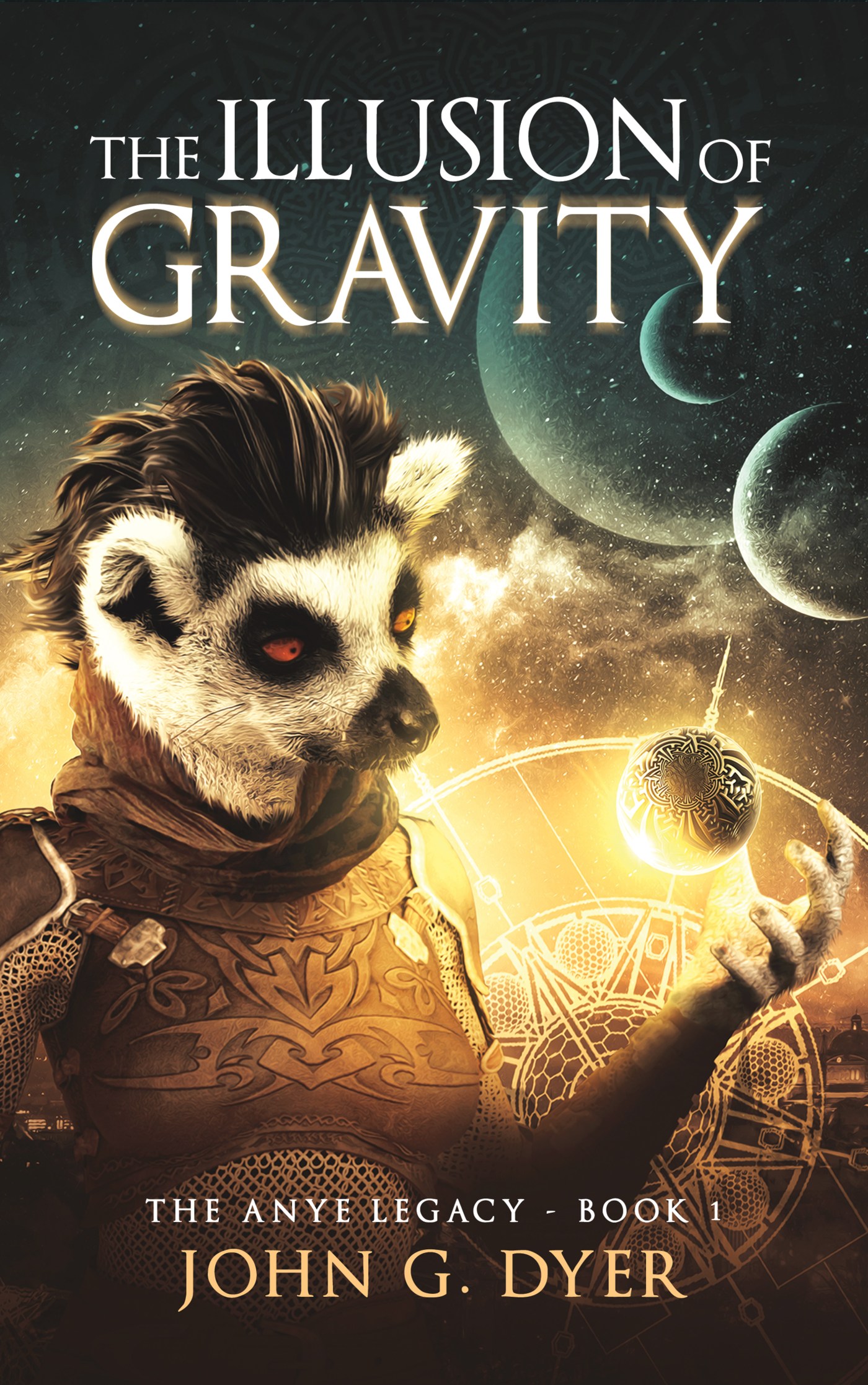
🌌 A sweeping blend of hard science, mythic depth, and moral reckoning.
The Illusion of Gravity is the rare kind of science fiction that takes itself seriously—not as space opera, not as shallow techno-magic—but as an act of philosophical engineering. It builds a fully realized world from the ground up: linguistically, biologically, and politically. Dyer’s Vidura is not just another “alien planet”; it’s a mirror to our own civilization—a hybrid of futuristic possibility and genetic hubris where social decay, scientific stagnation, and existential dread intermingle beneath the polished surface of “progress.”
The premise, on its face, is classic speculative physics: a young physicist’s experiment threatens to unmake the limits of time, space, and causality. But what Dyer really depicts is a civilization paralyzed by institutional complacency. The technological ceiling has held for centuries; the bureaucrats, scientists, and spiritualists drift in their own arrogance while their sun literally begins to fail. It’s a striking allegory for our present human condition: moral entropy disguised as advancement.
You can see echoes of Herbert’s Dune, Asimov’s Foundation, and even Clarke’s cosmic awe, reinforced by anthropological precision—Indo-Aryan linguistics, cultural layering, caste-like species divisions. But Dyer’s approach is tighter, more intimate, and morally darker. His characters—especially Rivan Saraf and his family—embody that tension between duty, discovery, and damnation. The science has sharp edges; the politics, sharper still.
And yet at the heart of it lies a human question: what happens to a culture when its heroes have lost the capacity for wonder—but not for pride?
Dyer writes with authority on physics and metaphysics, giving just enough scaffolding for readers to understand his “transdimensional filaments” and “gravitic tensors”—concepts that feel, at times, like early sketches of real theories awaiting discovery. His language—dense, linguistically rich, and punctuated with Indo-Aryan cadences—demands your attention. It’s not for casual readers. But for those who crave speculative fiction that respects their intelligence and challenges their assumptions, it’s a treasure.
In short:
If you want a novel that feeds your curiosity rather than pacifies it, if you suspect that “progress” in our world might really be stagnation with better branding, and if you love fiction that fuses science with spirit, this is for you.
It’s not an easy read. It’s not meant to be.
It’s a mirror—one that dares you to ask whether gravity itself might be the least of our illusions.


 John Dyer Writes
Leave a comment