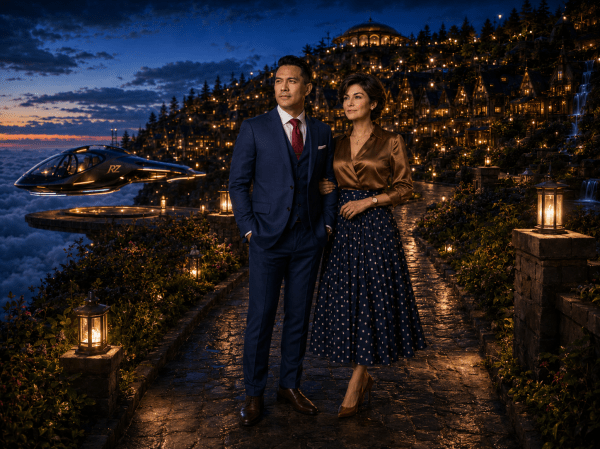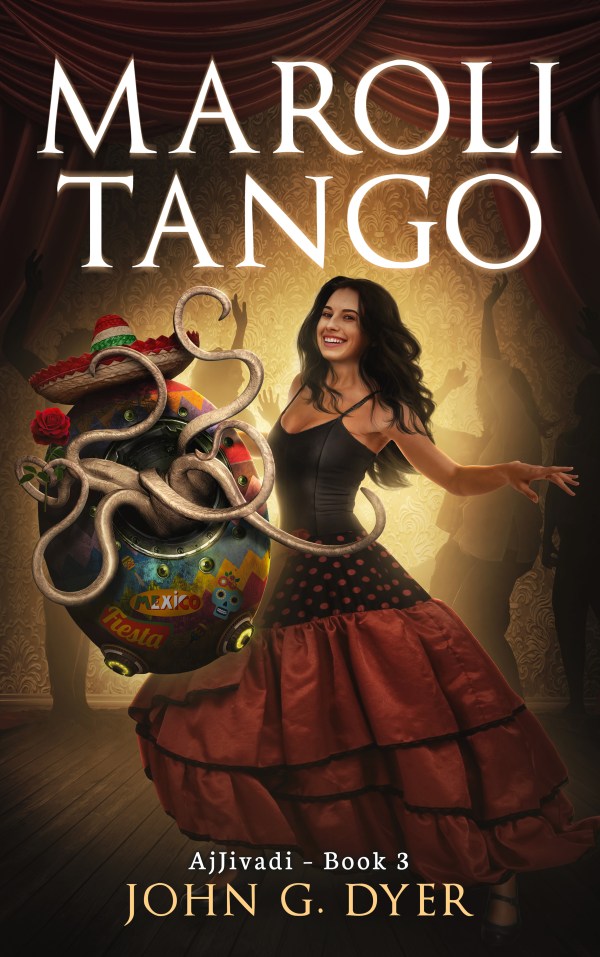
Let’s Make a Music Video ~ Step 2

The song is You Make My Dreams Come True by Hall and Oates

ChatGPT replied:

Perfect. That song points us toward a romantic, exuberant “this is why the world is worth saving” video, not a synopsis.

The original Voices version runs about 3:10, so we have enough room for perhaps 35–45 distinct edits, but probably only 18–25 genuinely animated source shots if we reuse some intelligently through crops, speed changes, and alternate camera moves. (Spotify)

The central conceit I’d use is:

An extinction story edited as a love song.

That fits Maroli Tango beautifully. The cosmic threat is present, but the song keeps insisting visually that civilization is made out of people who are delighted to be alive.

The protagonists should dominate

I would make Carmen and Brandon the spine of the video, with Mason and Marie as the younger mirror couple. Then we use the rest of the cast—Erin, Clarke and Loretta, Samuel and Maryanne, the Maroli, Anye, spacecraft crews, Washington people—as the expanding circle around them.

Not:

Earth is doomed → people struggle → Earth is saved.

More like:

Look at these ridiculous, wonderful people → look at this enormous strange universe they inhabit → somebody is threatening all of this? → absolutely not.

That is much more compatible with Hall & Oates.

Rough 3:10 visual architecture

TimeVisual ideaEditing
0:00–0:13Establish the world3–4 confident cinematic shots
0:13–0:40Carmen + BrandonLonger character shots, glances, walking, dancing
0:40–1:00First releaseFaster cuts; Mason/Marie enter
1:00–1:30Expand the universeFamily, Anye, Maroli, ships, Earth/Jivada
1:30–1:53Romance doubles downCarmen/Brandon ↔ Mason/Marie match cuts
1:53–2:17Stakes intrudemilitary, Dust Cloud, missile, tense meetings
2:17–2:42Joy fights backrapid ensemble montage, action with optimism
2:42–3:02Big final runstrongest spectacle + strongest human moments
3:02–3:10Buttonone intimate image, then title

Those timestamps are editorial placeholders until we’re working against the exact audio file/version.

The opening should be fun

I would not begin with the micro-nova.

Imagine that keyboard opening against perhaps:

  1. black;
  2. Vidura/Earth/space establishing frame;
  3. a big Anye vessel sliding majestically through frame;
  4. immediate hard cut to something very human and slightly funny;
  5. Carmen sees Brandon.

Then the song becomes theirs.

The audience learns almost instantly: This isn’t going to be three minutes of portentous science-fiction imagery.

Carmen and Brandon

Their material should be unusually restrained.

We already have spectacle elsewhere. Their shots need micro-performance:

  • Carmen notices Brandon across a room.
  • Brandon suppresses a smile.
  • Carmen’s expression changes before she looks away.
  • His hand appears at the edge of the frame.
  • They walk together.
  • The first-dance material becomes extremely valuable.
  • Presidential imagery can be juxtaposed with tiny private reactions.

PAI should not be asked to make them perform elaborate choreography. For the dance, for example, a good start frame plus a gentle turn, garment movement, weight shift, and orbiting camera will probably sell it.

Mason and Marie

These two should provide more physical energy.

We can afford:

  • running;
  • aircraft activity;
  • laughing;
  • turning toward each other;
  • uniform movement;
  • cockpit motion;
  • youthful impulsiveness.

And I would use match cuts between the two romances.

Carmen turns her head → Marie completes the turn.

Brandon extends a hand → Mason extends a hand.

Marie looks upward → Carmen looking at some enormous ship.

That makes the generations feel connected without explaining anything.

The science-fiction imagery

Here is where the song gives us permission to have fun.

A 335-meter flying estate doesn’t always have to appear ominous.

Let it swoop.

Let the Rangers move.

Let the Maroli zip through a room.

Let a fighting drone pivot toward camera precisely on a musical accent.

Let augmented-reality displays burst to life.

Let a ship clear frame on a snare hit.

The technology becomes part of the choreography.

Even the huge spacecraft should occasionally move with almost musical confidence, rather than the ponderous 2001 treatment we’d normally give them.

Then, briefly, threaten everything

Around the latter middle, we introduce perhaps 20–25 seconds where the images suddenly tell us there really is something at stake:

Dust Cloud Spiral.

Military alert.

Carmen in presidential mode.

Missile.

Phase cancellation.

Command deck.

People looking frightened.

But don’t change songs emotionally. That’s the trick.

The relentlessly happy music over dangerous imagery says something very specific:

These people have decided they’re going to win.

That feels extremely Carmen Benequista.

Final run

The last section should become a cascade of payoff images:

Carmen → Brandon
Mason → Marie
Erin
Clarke/Loretta
Anye faces
Maroli
Washington
France
Mahacamu
ships
Earth
children
laughter
cockpit
Carmen again
Brandon again

Then resist the temptation to finish on the biggest spacecraft shot.

Finish on a person.

My instinct would be Carmen and Brandon, preferably an image in which they aren’t behaving like President and security/intelligence man at all.

Then:

MAROLI TANGO

Maybe one final small visual joke after the title if the music gives us enough tail.

Most important production decision

For this particular song, I would animate expressions more than actions.

PAI can make a spaceship fly. That’s easy spectacle.

What will make this video work is:

Carmen’s eyes finding Brandon.

Marie grinning at Mason.

Erin reacting to something impossible.

A Maroli doing something unexpectedly personable.

Those are the shots people remember.

And because the song itself supplies so much rhythmic propulsion, we don’t need every generated clip to contain major motion. The edit supplies the dancing.

The next thing I’d do is start an actual start-frame board: we identify the strongest existing Maroli Tango illustrations one by one, assign each a likely place in the 3:10 arc, and mark it ANIMATE / CROP-ONLY / STILL / NOT FOR VIDEO. Once we have that inventory, we’ll know exactly which missing frames—if any—we need to generate specifically for PAI.

Let’s Make a Music Video ~ Step 1

Let us plan a music video built from Maroli Tango chapter illustrations. We will select start frames and task PAI Studio with animation and assembly.

ChatGPT replied:

The chapter illustrations are unusually well suited to this because they already function like cinematic keyframes. Rather than asking an image-to-video model to invent scenes, we can treat each illustration as a deliberately composed start frame and give PAI Studio narrowly constrained animation jobs.

I’d build the project in five passes.

1. Treat the song as the master timeline

Before choosing pictures, we map the finished music track into structural beats: intro, verse, lift, chorus, bridge, instrumental passages, final escalation, outro.

For each section we decide whether the visual should be:

  • narrative — recognizable events from Maroli Tango
  • character — Carmen, Brandon, Mason, Marie, Suban, etc.
  • world spectacle — ships, Virtuality, Dust Cloud Spiral, Washington, Jivada
  • emotional punctuation — a look, embrace, confrontation, isolation, revelation
  • kinetic transition — drone flight, spacecraft departure, city movement, camera travel

That keeps the video from becoming an illustrated chapter summary. It should feel like the emotional memory of the novel set to music.

2. Build a start-frame library

We go through the existing illustrations and classify them roughly like this:

TypeBest animation treatment
Close character shotbreathing, eyes, hair/fur, subtle expression, camera creep
Two-character dialoguerestrained body motion, glance changes, parallax
Interior scenecamera push/dolly, AR displays, environmental motion
Exterior citytraffic, atmospheric movement, signs/light, slow camera
Spacecraftcamera orbit, translation, atmospheric haze, distant traffic
Action imagestronger camera movement, debris, weapon effects, character movement
Virtuality/surrealtransformation, impossible camera travel, environmental morphing

Some images will make excellent 4–6 second shots. Others may support 8–10 seconds if there is enough depth.

A critical rule: don’t animate everything. Models get worse as the requested motion becomes more complicated. We want the existing illustration to remain recognizable.

For example:

Carmen doesn’t need to walk across a room.
She may only look toward Brandon while the camera moves slowly around her.

That can look much more expensive than attempting full-body performance.

3. Write animation directions as shots, not prose

For every selected start frame, we’ll create a compact production card.

Something like:

SHOT 17 — Carmen / White House

Duration: 5.5 sec
Start frame: Carmen chapter illustration
Camera: slow 15-degree arc right, slight push-in
Subject: Carmen remains nearly still; subtle breathing; eyes shift toward someone offscreen
Environment: curtains move faintly; distant city lights shimmer
Mood: controlled anxiety, private rather than presidential
Continuity constraints: preserve face, age, wardrobe, hairstyle, room architecture
Avoid: dialogue mouth motion, exaggerated head turn, new objects, costume changes

The important distinction is that we’re telling PAI what may move and what must not change.

For character continuity, I’d repeatedly specify:

  • preserve exact facial identity
  • preserve species anatomy
  • preserve costume
  • no added tails
  • no added fingers/limbs
  • no new characters
  • no text mutation
  • maintain illustrated/cinematic realism

Especially with the Anye and Maroli, anatomical restraint will matter.

4. Use the music video grammar to hide AI weaknesses

Rather than producing thirty-second generated sequences, I would favor short deliberate shots, probably averaging around 3–6 seconds.

A very rough rhythm might be:

Quiet verse: 5–8 sec shots
Build: 3–5 sec
Chorus: 2–4 sec
Instrumental/action passage: occasionally 1–2 sec
Emotional climax: return to longer shots

And not every transition needs generative animation. Hard cuts, dissolves, dip-to-black, match cuts, flash frames, and editorial reframing can do enormous work.

We can also reuse a strong illustration in multiple ways:

Shot A: wide composition
Shot B: crop on Carmen
Shot C: crop on Brandon
Shot D: animated full frame

Four visual beats from one piece of artwork without regenerating anything.

5. Give the video an arc independent of chapter order

For Maroli Tango, I would initially explore an arc something like:

I — Wonder
Earth, Anye civilization, Washington, ships, children, strange technology.

II — People
Carmen/Brandon. Mason/Marie. Domestic and human-scale images.

III — Something is wrong
Dust Cloud Spiral, military imagery, drones, meetings, increasingly uneasy expressions.

IV — Collision
Political confrontation, spacecraft, military action, rapid cutting.

V — Choice
Carmen becomes the visual center. The story stops being about whether somebody will rescue Earth and becomes about humanity deciding what it will do.

VI — Release
Large cosmic imagery followed by something surprisingly intimate rather than ending on the biggest explosion.

That would serve the central idea of Maroli Tango particularly well:

the fate of civilizations rendered through the decisions of individual people.


The practical workflow can therefore be:

song → timecoded beat sheet → illustration shortlist → shot order → individual PAI animation prompts → generated clips → assembly → identify weak transitions → create a handful of purpose-built bridge frames → final assembly.

I would resist generating new artwork until we’ve exhausted the existing chapter illustrations. Their consistency is an asset. Once the rough cut exposes an actual missing shot—we need Carmen alone here, we need an exterior of Bharamin here, we need Mason looking upward here—then we make that illustration specifically as a start frame.

The best next step is to give me the song/audio or lyrics. I can then turn the actual track into a shot-by-shot visual treatment and we can start choosing which existing Maroli Tango illustrations belong at each musical moment.

117 ~ Breakthrough

Another excerpt from the Maroli Tango WIP serialization on Substack

Glenn Mehrenholz stood at the center of his augmented reality playground on Ghost Town deck, flying a covey of drones through Iron Arrow Vidura’s scrap orbit.

Illuminated by harsh sunlight, material floated in vacuum as if collected by a magnetic crane from the shredder bin at a celestial automotive junkyard — irregular clusters, one side flat, the other spiky, set adrift to assemble into razor-sharp, deeply textured, strobe-light-decorated navigation hazards the size of battleships.

Glenn told his wife, “I don’t know what I thought I’d find, but it wasn’t this.”

Arya touched an icon on a virtual console, adding a map layer to the scene. “Iron Arrow’s survey says we’re in the recycling mill input zone.”

“I’m looking for QA rejected plate.” Glenn pushed the scene away, moving viewer perspective outside the range of the drones’ cameras. Scene resolution deprecated. Map annotation remained in-focus, leading them to another site.

Glenn groaned. “Asteroids. Unprocessed.”

“You won’t be welding those into a sphere.” She took a moment to appreciate where she was. “Look! There’s Vidura!”

“And all three moons.” He listened to his phone’s Oma. “Do you want to accept a teleconference request from Ted Clarke?”

A minute later, Colonel Theodore Clarke appeared in the scene. He said, “We might have picked up a stalker.”

Arya replied, “Tell him to stand in line.”

“Ha ha.” Clarke walked into the sim. “One of PR’s directors didn’t like being let go. She gave Vik Abhianta an earful, making noises like a Vidura United activist.”

Glenn shook his head. “Never heard of them.”

“Communists, atheists, militant vegetarians.”

Arya said, “I thought Vidura was supposed to be a land of wholesome common sense.”

“Every culture has defective citizens.” Clarke looked around. “What are you up to here?”

Glenn said, “Trying to figure out how to test a missile defense exploit.”

“What’s the issue?”

“The device creates an N-Space disturbance. What it will do, we think, is impose a Saraf-Drive no-fly zone. What it might do is tell our enemies where we are, interfere with ansible communications and maybe even cause our souls to disconnect from our bodies.”

Clarke gave him the weird eye. “You mean like, bring on the Rapture?”

“We’ll test it on livestock.”

“Cows have souls?”

“Yes.”

“Fish?”

“Depends on which fish. An organism needs a neuron count above three hundred million to get a soul. Sharks have souls, but most cold-blooded animals do not.”

“Dogs have souls?”

“Yep, and there’s no way I’m going to send a dog.” Glenn scratched his chin. “I’m thinking we’ll do it after we figure out how Saraf Drive works.”

“Will that be soon, or …”

Glenn shrugged, “My feeling is soon. Could be wrong.”

Arya asked, “Did you really break legs at the Pentagon?”

Clarke nodded. “My guys flashed a couple of Saraf Drive vans directly into a hallway, kicked open a conference room door, and thrashed the bejesus out of a bunch of Navy pussies.”

“Holy smokes!”

“If you want to see big talkers turn into crybabies, I’ll send you the video.”

Glenn touched his ear. “Are we running an ad?”

They were shortly joined by Glenn’s collaborator at Parsanda Research on Vidura. The man asked, “Is this a bad time?”

Arya waved. Colonel Clarke waved. Glenn said, “Nah. We’re just standing around in augmented reality, which makes it a good time. What do you have?”

A magic clearboard appeared in the scene. Glenn stared half-baffled at lines of cursive notation. “You know I can’t read the modern script, right?”

“I did the calcs the hard way, then I asked your secret science modeler to posit five permutations of time using observations from all experiments, including your fast time demo, and find a solution for loopback.”

Glenn groaned. “Oh, no. Don’t tell me it was that easy.”

“Oh, yes. Negative curvature of space-time, sitting right behind the volume in a tesseract. We could have had high-performance Saraf Drive all along.”

Glenn closed his eyes. “That means the Unseen might have it.”

Read the serial novel here.

Undiscovered, but improving

I had a post occupying this spot until yesterday. I kept the headline because it signified what I originally intended to talk about, but the rest was an embarrassment — and not because I failed to express myself. No, I had my skirt over my head all right, displaying a poor attitude, complaining that after 4 novels published and 50 units sold, I’d only garnered 11 reviews.

But then I realized, considering how little I’ve done to promote the work, that might be an acceptable ratio — and the reviews were encouraging.

Joshua Grant described The Illusion of Gravity as ‘Sci-fi with substance’. Mary Jo Fletcher doesn’t read SF, but she enjoyed the book. (Mary’s a friend; I’m sharing it anyway.) Everyone liked Silken Thread (adventure/love story), although I’m told it was too fast paced, and the hero didn’t fail enough. Joshua Grant again weighed in on Resilient, praising the book for action, depth, an immersive quality, and creative use of linguistics — that last observation just tickling the heck out of me, because it’s something I think I have an ear for.

If one isn’t selling a lot of books, the Amazon dashboard allows authors to observe the habits of Kindle patrons. You can witness a reader giving up after X number of pages, which I haven’t seen a lot of. What I have seen is The Illusion of Gravity consumed in one sitting, followed by the next two books over a period of 3 days, then Silken Thread — again, in one sitting.

Continue reading “Undiscovered, but improving”

Blog at WordPress.com.

Up ↑