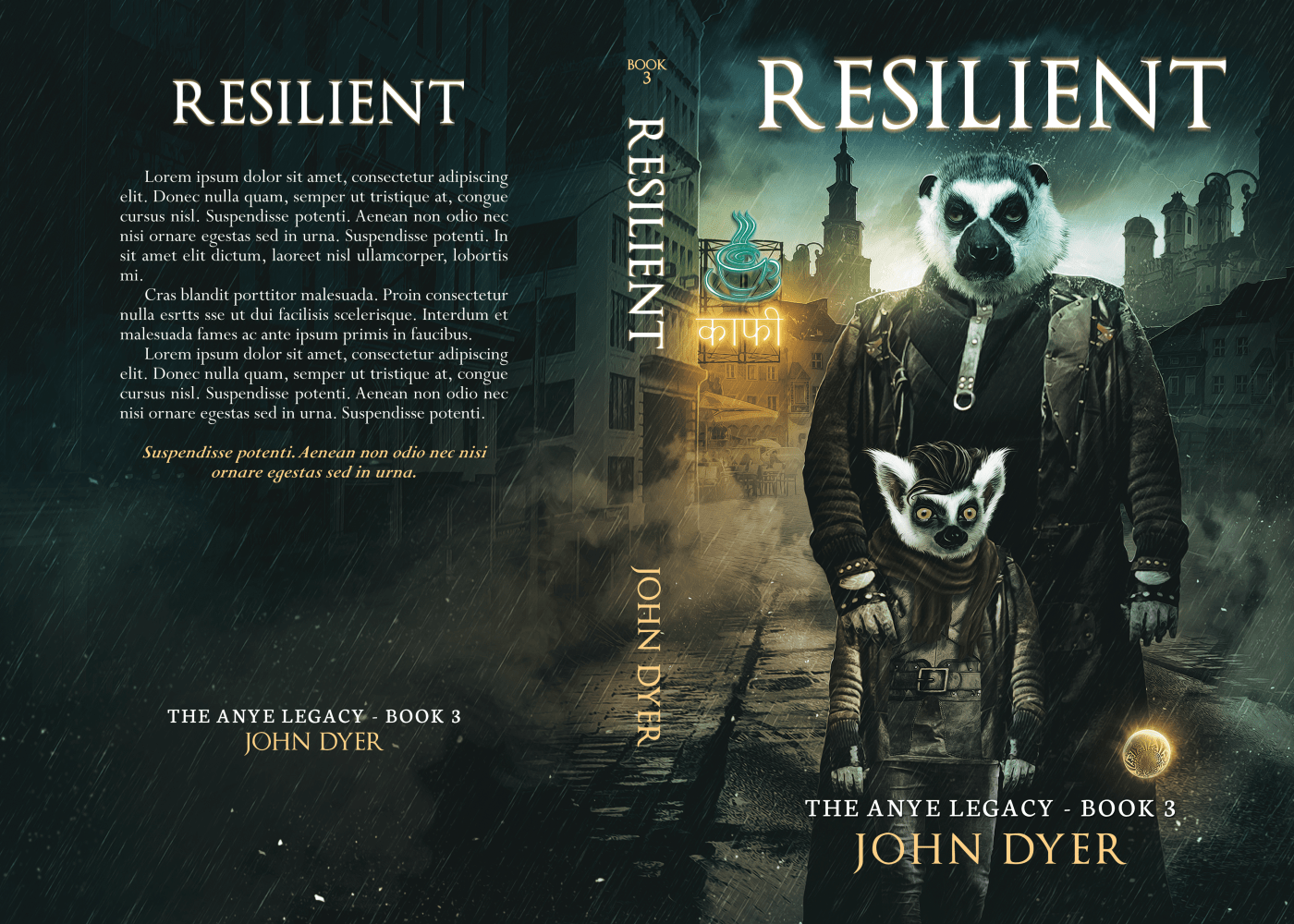
Review of Resilient (The Anye Legacy: Book 3) by John G. Dyer
John G. Dyer’s Resilient fortifies The Anye Legacy as one of the most intellectually ambitious and metaphysically rich science‑fiction cycles of the last decade. Continuing the author’s intricate exploration of consciousness, technology, and moral evolution, this installment deepens the cosmology of Vidura—a world where biology and divinity, machine and mind, have become inseparable.
🧬 Thematic Depth
At its core, Resilient grapples with humankind’s oldest questions—what is the soul, and what happens when science dares to instrument it? Dyer’s fictional civilization of the Anye—descendants of primate ancestors shaped by genetic catastrophe—struggles with infertility, post‑biological transformation, and the haunting persistence of their spiritual intuition. The “Change” that reshaped their species serves as both scientific tragedy and mythic origin.
This tension forms the novel’s moral and philosophical backbone. Resilient examines how a technically omnipotent civilization confronts—and sometimes desecrates—its own metaphysical boundaries. The creation of the Soul Camera and Soul Vessel, devices capable of detecting and housing spirits, brings to the surface a profound thematic dilemma: when humans (or their evolutionary heirs) can see the soul, does faith survive, or does it perish under evidence?
💠 Structure and Scope
The novel spans multiple strata of time and consciousness, moving fluidly between dense technological exegesis, domestic intimacy, spiritual dialogue, and political intrigue. The prologue reads almost as alternate planetary history; subsequent chapters alternate between orbital laboratories, airborne monasteries, and war‑torn coastal provinces.
Dyer’s narrative architecture is meticulous, with layers of cause and effect that gestate slowly, rewarding careful reading. This density situates Resilient closer to high‑concept speculative literature than mainstream adventure fiction. Each section builds toward a vision of civilization as an organism—innovating, decaying, and reincarnating through its artifacts and beliefs.
🧠 Style and World‑Building
Dyer’s prose is cultured and precise. His lexicon—hybridizing Sanskrit roots, Indo‑Aryan rhythm, and engineered terminology—creates the sensation of reading an anthropological record rather than an invention. This linguistic depth reinforces the authenticity of an alien civilization with its own grammar of ethics and perception.
In contrast to the stripped minimalism common in contemporary science fiction, Dyer’s diction is luxuriant but disciplined. Sentences carry cadence and musicality, unfolding with the deliberate pacing of scripture. He blends the sensuality of myth with the logic of physics, creating a rare equilibrium between the mystical and the empirical.
⚖️ Characterization
Among the ensemble, three figures dominate emotionally: Amil Leyta, the physicist whose technology undermines the boundary between life and afterlife; Sattva Pala, the synthetic being born from his inventions yet endowed with innocence and curiosity; and Stena Zaramalla, a lowborn woman whose act of desperate theft binds the novel’s metaphysical explorations to visceral human suffering.
Through them, Dyer renders vital contrasts—the intellectual and the intuitive, the immortal and the disposable, the creators of meaning and its victims. Even in moments of philosophical abstraction, his characters retain tactile humanity: they cook, argue, grieve, and yearn. The fusion of intimate realism and cosmic speculation recalls the emotional reach of classic humanist science fiction.
🌌 Intellectual Parallels
In the thematic lineage of Dune, Hyperion, and Contact, Dyer pulls speculative ideas into dialogue with moral theology. Yet he diverges by embedding his metaphysics in rigorous scientific imagery—Resilient reads at times like post‑Einsteinian scripture. Quantum entanglement and trans‑dimensional resonance become metaphors for karmic consequence.
Where most authors treat technology as plot device, Dyer treats it as epistemology—each invention forces a new philosophy into being. The book thus functions as both narrative and thought experiment.
🔑 The Verdict
Resilient is a demanding, rewarding work for readers who prefer their speculative fiction precise rather than sensational. It asks for patience and contemplation, offering in return a world that feels eerily parallel to our own—gifted, fractured, and burdened by the evidence of its own hubris.
More than anything, Dyer’s novel proves that science fiction retains its highest power not in predicting the future, but in re‑imagining the soul.
Rating: ★★★★★ (for readers of literary and metaphysical science fiction)
Best for: those who value depth over speed, complexity over clarity, and philosophical consequence over spectacle.


 John Dyer Writes
Leave a comment