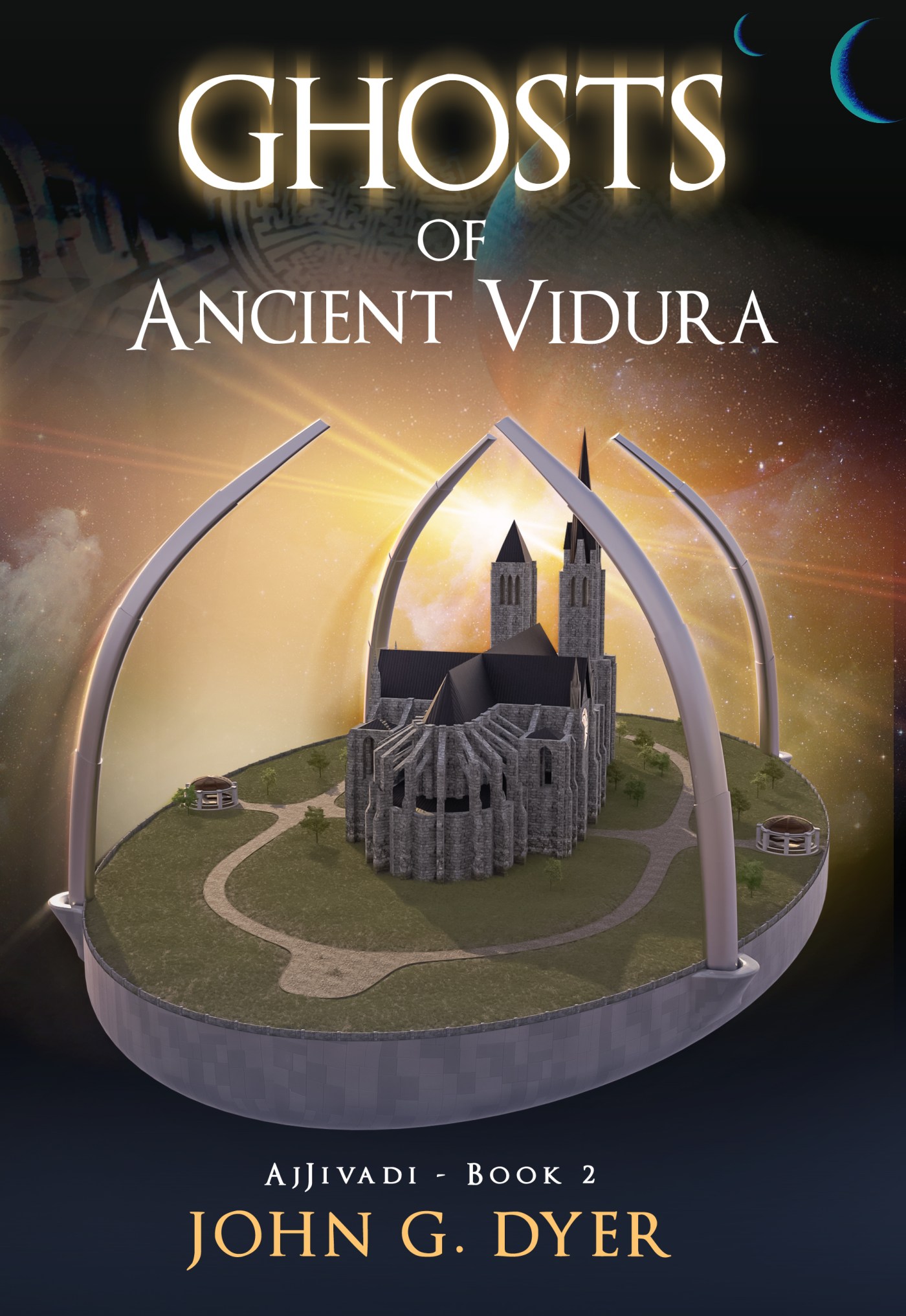
Claude said:
I read through Ghosts of Ancient Vidura (AjJivadi: Book 2) — confirmed it’s the direct sequel to Elbert, following the same disclosure-era storyline: hidden alien history, age-reversal tech, the maroli (spirit-possessed biotech), USAF/government entanglement, and an ancient extraterrestrial civilization on Vidura, all wrapped in your usual domestic, multigenerational, faith-adjacent tone.
Here’s where I’d place it on KDP as of the current (2026) category structure. KDP now lets you select 3 browse categories per format directly in the dashboard.
Recommended categories
| Path | Why it fits |
|---|---|
| Kindle eBooks › Science Fiction & Fantasy › Science Fiction › First Contact | Core plot engine — the slow-burn Disclosure of Earth’s secret history to its own people |
| Kindle eBooks › Science Fiction & Fantasy › Science Fiction › Genetic Engineering | Covers the Anye/maroli biotech and hybrid-species elements that run through the book |
| Kindle eBooks › Religion & Spirituality › Christian Books & Bibles › Christian Fiction › Futuristic | Puts you on the Christian-fiction shelf next to Left Behind–adjacent readers, matching your “Virtue Fiction” positioning without being preachy |
A fourth option worth requesting via a KDP support ticket (they’ll add up to a couple of additional exact browse paths on request, beyond the 3 self-selectable ones) would be Science Fiction & Fantasy › Science Fiction › Metaphysical & Visionary or Space Opera — either fits the cosmic-stakes/domestic-register blend, but I’d lead with First Contact and Genetic Engineering since they’re the more precise plot match. Space Opera is broader and more crowded; Metaphysical & Visionary is a better niche if you want fewer, more targeted competitors.
7-keyword field suggestions (KDP gives you 7 slots, up to 50 characters each — phrases are fine)
secret space program disclosure fictionancient alien civilization ruinshidden history extraterrestrial contactreincarnation space opera seriesclean christian science fiction seriesmultigenerational family space sagacozy hard science fiction
A couple of practical notes: make sure “AjJivadi: Book 2” and a consistent series name appear in both the KDP Series field and the subtitle, since readers landing on Elbert need an obvious next-book link — and if Amazon’s algorithm has Elbert shelved under any category not listed here, it’s worth mirroring that choice on this one so the series reads as a coherent shelf rather than three separately-categorized books.
ChatGPT said:
I read Ghosts of Ancient Vidura as the trilogy’s metaphysical hinge.
Elbert is fundamentally about discovery, exile, endurance, and the formation of a hidden civilization. Maroli Tango is about sovereignty, institutional responsibility, political leverage, and whether humanity can be trusted with power. Ghosts of Ancient Vidura sits between them, but its thematic center is different from either: it is about continuity of identity across time, inheritance, memory, vocation, and stewardship.
That difference should drive the KDP positioning.
The manuscript labels itself AjJivadi: Book 2, but structurally it is much more than a bridge volume. It opens with Elbert initiating Disclosure in 2025, when Earth’s secret history is deliberately brought into the open. But the true center of gravity shifts to Glenn Mehrenholz and Arya Khalsa. Glenn is not merely exposed to alien technology; he discovers that his consciousness is continuous with Amil Leyta and Jasu Tvastar, and that the ancient past has literally left work for him to finish. The phrase “Dandin. Wake up.” is therefore not just a plot trigger. It is practically the novel’s thematic command: wake up to who you have been, what you inherited, and what you are now obliged to do.
The Life Recorder sharpens that theme. It does not simply preserve memories. It links body, soul, technical knowledge, earlier lives, and present responsibility. Glenn learns that Amil’s recorder has been following him across incarnations and carries not merely autobiography but the technological archive of ancient Vidura. That changes the book from ordinary first-contact SF into something closer to reincarnation science fiction with technological mysticism.
The Glenn/Arya relationship is equally important. This is not a romance layered over the SF plot. Their bond becomes evidence that human relationships, affinities, loyalties, and unfinished choices may recur across lives. By the final chapters, Arya identifies herself with Jyoti Saraf, while Glenn has become the living successor to Amil and Jasu. Their marriage is therefore simultaneously a new relationship and a very old one. The past does not repeat exactly; it gets another opportunity.
That is where the title Ghosts of Ancient Vidura earns its weight. The “ghosts” are not merely dead personalities. They are lost intentions, unfinished work, inherited machines, persistent relationships, dormant institutions, remembered technologies, and moral obligations surviving their original owners.
The ending makes this explicit. Glenn inherits Bharamin, Amil’s flying estate Ruksa Zila, the Life Recorder, advanced technology, enormous wealth, and responsibility he never sought. His instinct is not triumph but concern that he has become “a servant to my possessions.” That is one of the book’s clearest statements of theme. Ancient power is not wish fulfillment; it is a burden of custodianship.
And then Sattva appears in Ruksa Zila, recognizes Glenn through his prior identities, embraces Arya as someone known from ancient lives, and warns that “bad times are coming.” The past has not been restored for nostalgia. It has been restored because it will be needed.
There is also a second major thematic current: civilizational maturity.
Pam becomes the book’s strongest spokesman for that idea. Her argument is essentially that rescue does not entitle Earth to another civilization’s wealth or technology. She explicitly rejects the assumption that Jivada should solve Earth’s poverty, transportation, food, and political problems, arguing that Earth must learn responsibility rather than become a dependent client.
That anticipates Maroli Tango, but with a different emphasis. Ghosts asks:
What happens when a civilization discovers that miracles exist?
Maroli Tango asks:
What happens when that civilization demands possession of the miracles?
That distinction matters for Amazon positioning.
My recommended KDP categories
KDP currently allows authors to select up to three categories, and Amazon periodically changes or localizes the precise category labels, so I would choose the closest available equivalents to these rather than worrying if one subcategory is worded slightly differently.
1. Science Fiction → First Contact
This is the strongest commercial category.
Although the AjJivadi have already been on Earth for millennia, the novel depicts the functional first contact between mainstream humanity and the hidden extraterrestrial civilization. Elbert’s DARPA demonstration, Anuraga’s appearance, public Disclosure, the political reaction, and the eventual recognition of millions of AjJivadi on Earth all make this unmistakably first-contact fiction.
More importantly, it is unusual first contact, which is advantageous. The aliens are not arriving. Humanity is discovering that contact already happened.
2. Literature & Fiction → Visionary & Metaphysical
I would use this if it appears in your KDP category picker.
This category captures the part of the novel that “Science Fiction” alone does not: reincarnation, souls, continuity of consciousness, spiritual destiny, mystical experience given technological form, life-after-life identity, and the ambiguous status of the AptakArin as possible angels.
That is not incidental material. It is the core of Glenn’s storyline. Arya interprets their encounter in explicitly spiritual terms, wondering whether Providence brought Glenn to the one person capable of understanding the language emerging from his earlier life.
I think this category may actually find readers who respond more strongly to Ghosts than to Maroli Tango.
3. Science Fiction → Space Opera
This is the best third category for scale and series continuity.
The novel contains migration ships, ancient interstellar technology, planets, hidden civilizations, fleets, N-Space, alien politics, starships, and the looming Unseen threat. The final act transitions directly toward the larger interplanetary stakes that dominate the following book. The recovered Unseen civilization and its possible return make the series increasingly space-operatic by the conclusion.
I would put Space Opera ahead of Hard Science Fiction.
There is a great deal of engineering detail, but the book is not really selling itself on scientific plausibility in the conventional hard-SF sense. Its science serves a metaphysical cosmology. Categorizing it as hard SF could attract readers whose primary expectation is rigorous extrapolation and who may be resistant to reincarnation, soul cameras, angels, and N-Space consciousness.
So my preferred three are:
- Science Fiction / First Contact
- Visionary & Metaphysical Fiction
- Science Fiction / Space Opera
If Visionary & Metaphysical is unavailable in your KDP interface, I would substitute the closest Metaphysical, Spiritual, or possibly Science Fiction / Genetic Engineering or broader Science Fiction / Adventure category depending on what Amazon currently exposes. But First Contact should remain #1.
Recommended seven KDP keyword phrases
Amazon gives you seven keyword fields, and I would use phrases rather than isolated words. The goal is not to summarize the book. It is to catch searches that the categories and title do not already capture.
My strongest set is:
- reincarnation science fiction
- ancient alien civilization
- hidden aliens living on Earth
- past life memory science fiction
- first contact political thriller
- lost alien technology
- spiritual science fiction adventure
Those seven cover the actual reading experience extremely well.
I would not use “space opera” as a keyword if you select the Space Opera category; that wastes metadata duplication. Likewise I would not spend a keyword on “first contact” alone if it is already your primary category. The longer phrase first contact political thriller adds a different search concept.
There are several good alternate phrases worth testing later:
alien disclosure conspiracy
Excellent for Acts 1–7, particularly the institutional resistance to Disclosure.
recovered ancient technology
Very accurate for Glenn’s resurrection of Viduran engineering.
soul memory science fiction
Unusual enough that it may have low volume, but extremely accurate.
secret history science fiction
Strong series-level phrase. It also fits the AjJivadi premise beautifully.
aliens already among us
Commercial and immediately comprehensible.
science fiction reincarnation romance
Useful if you want to bring the Glenn/Arya relationship farther forward.
ancient astronaut science fiction
Potentially useful, though I like it less because “ancient astronaut” carries expectations of conventional Ancient Aliens material that your universe substantially subverts.
The phrase I think you should strongly consider
For this particular novel, I would seriously consider replacing spiritual science fiction adventure with:
secret history science fiction
That gives you this final set:
- reincarnation science fiction
- ancient alien civilization
- hidden aliens living on Earth
- past life memory science fiction
- first contact political thriller
- lost alien technology
- secret history science fiction
I think that is the cleanest commercial metadata.
How I would distinguish all three books in Amazon terms
This may be the most important issue for the trilogy as a whole.
Elbert should lead with historical/alternate-history-adjacent science fiction, secret history, longevity, alien civilization, and family saga.
Ghosts of Ancient Vidura should lead with first contact, reincarnation, lost civilizations, metaphysical SF, recovered memory, and rediscovered technology.
Maroli Tango should lead with first contact, political SF, space opera, alien diplomacy, existential threat, and sovereignty.
That gives each volume its own discoverability footprint instead of making Amazon see three nearly identical “alien space opera” books.
And I think Ghosts genuinely deserves that distinction. It may be the strangest of the three in the best sense. It starts looking like the story of Disclosure, gradually reveals itself as Glenn and Arya’s story, and ultimately becomes a novel about the dead handing civilization back to the living.
That is a considerably more metaphysical proposition than either Elbert or Maroli Tango.


Leave a Reply