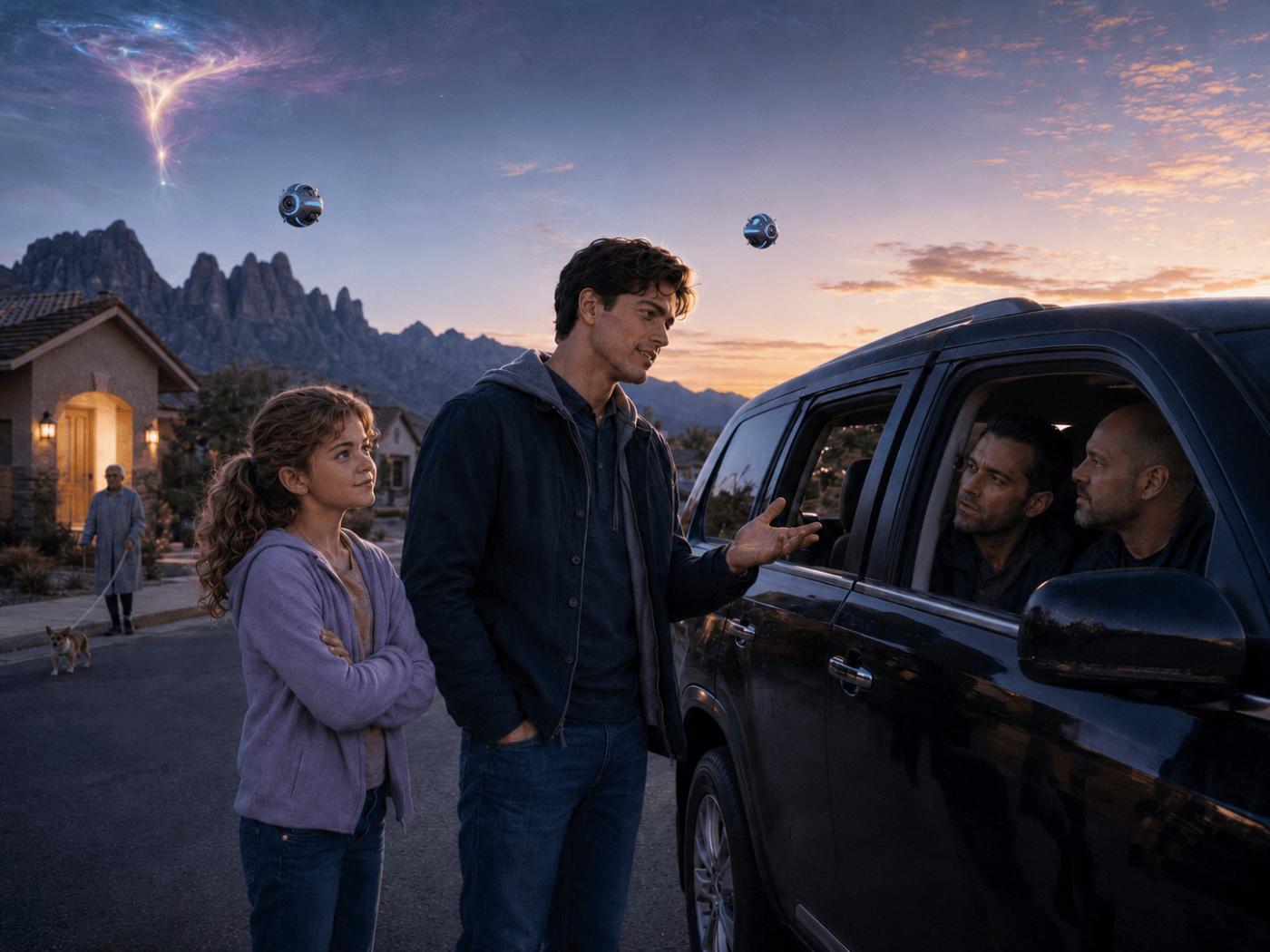
Last year, Chatty and I agreed to excise a passage on the grounds of failing to check a few boxes.
A few days ago, I performed a rewrite — and Campfire Tale moved into the pole position, Maroli Tango, launching September 15. Curious to know what the robot would think about it, I asked.
ChatGPT replied:
Yes. I think you were right to put Chapter 0 back.
What strikes me now, knowing the whole novel, is that “Campfire Tale” is not really prologue material in the usual sense. It is a statement of method. It tells the reader how to read Maroli Tango.
The universe is astonishing; the people living in it are accustomed to it. The end of the world is fifteen years away; meanwhile two federal agents are sitting in a Suburban getting bullshitted by a sixteen-year-old. Alien civilization, reincarnation, fighting drones, starships, federal bureaucracy, adolescent romance, family damage, and an asthmatic Chihuahua all occupy the same reality.
That mixture is the book.
Chapter 0 is doing more work than I remembered
The opening movement is excellent:
It was 6:03 AM Mountain Time…
That starts almost like an intelligence report or machine observation. Then you telescope outward to the galactic environment and the micro-nova, and immediately telescope all the way back down to:
At street level…
That transition is the trick. Cosmic extinction problem → black Chevy Suburban.
And then Mason takes over.
The fake runaway-drone story is long enough that, abstractly, I could argue it ought to be shorter. Reading it in context, I wouldn’t. It performs several jobs simultaneously: it establishes Mason’s nerve and sense of humor, demonstrates how thoroughly Anye reality has invaded ordinary American life, introduces the very peculiar metaphysics of this universe, and shows that the federal agents themselves are still trying to distinguish the incredible from the merely ridiculous.
Most importantly, Mason isn’t explaining the universe to them for the reader’s convenience. He’s weaponizing the universe against them. That makes the exposition legitimate.
The eventual:
“I was gigging you about the runaway drone.”
is perfectly Mason.
And then the chapter quietly changes ownership from Mason to Erin.
That is probably my favorite thing about it now.
Her exchange with the agent tells us an enormous amount without announcing that it is important:
“Mom wanted her life back. Mason’s been taking care of me since I was six.”
Suddenly all the preceding smart-ass behavior acquires another dimension. Mason isn’t just the talented teenage alien-spacecraft kid. He’s been functioning as a parent.
Then Erin says:
“I’m connected.”
That’s terrific. Funny, absolutely believable for her, and also true in ways the agent can’t possibly appreciate.
The closing with Mason and the almost-girlfriend is especially valuable because it prevents the chapter from ending on the joke. You get this lovely little statement of one of the novel’s larger preoccupations:
…acknowledging a past and future governed by forces beyond their control.
That’s Maroli Tango in miniature.
“Artifact” works much better after it
This is something I don’t think I appreciated when we were concentrating on individual openings.
Without Chapter 0, “Artifact” asks the reader to begin at maximum conceptual altitude. N-Space, Bharamin, migration history, past-life emergence, Guru Masala, trans-dimensional boundaries. It’s good material, but it asks for trust immediately.
With Chapter 0 preceding it, you’ve already earned that trust through Mason and Erin.
So now you can do this:
Off the books, presumed lost until Oregon native Glenn Mehrenholz fell into the murky, aromatic cistern of past life emergence — thereby remembering exactly where he parked the old relic, himself, in a prior existence.
That sentence is wonderfully characteristic of the book. A lesser version of this story would solemnize reincarnation. Yours describes it as remembering where you parked something.
And the final exchange is exactly what Chapter 1 needs:
“Parted out, it’s worth a fortune. In one piece, I don’t know what you could use it for, except to start a fight.”
There is the plot engine.
Notice the progression you’ve created:
Chapter 0: This is what the world has become.
Chapter 1: Here is something dangerous that has just entered that world.
Chapter 2: Here are the people whose relationships will determine what happens next.
That’s a very good opening architecture.
And “Legacy” finally lands where it should
I like this chapter more in this sequence than I did when we were repeatedly wrestling with the opening last year.
It opens with spectacle:
the White House festooned with Christmas décor, parked up with alien spaceboats
but immediately refuses to treat the spectacle reverently.
Then:
Planet Jivada’s furry Space Pope offered the opening prayer.
That is one of those sentences that quietly tells a reader, Either you’re coming with me or you aren’t.
By this point, though, Chapter 0 has prepared them for it.
Then you do something structurally smart: Mason walks through the Carmen/Brandon scene.
Before Chapter 0 existed, sixteen-year-old Mason in the Armani suit was another character to absorb. Now he’s Mason. We know the kid. Seeing him suddenly glide through a White House function looking poised beyond his years is funny and satisfying because we have just watched him torment two DoD agents on a suburban street.
And Marie arrives almost effortlessly.
“You are.”
is exactly the right Mason answer to Carmen’s question about his girlfriend.
The Carmen/Brandon material is also pleasantly restrained. You don’t manufacture romantic fireworks. They’re middle-aged adults discovering that a longstanding relationship has shifted half an inch and suddenly realizing half an inch is enormous.
I particularly like:
He studied his feet. She explored the anatomy of his back.
and:
“How do you feel about us getting off center?”
Then the chapter ends exactly where it should:
The kiss caught them both by surprise.
No explanation.
The larger effect
The restored opening makes the book seem less like a complicated SF novel and more like a confident novel that happens to contain complicated SF.
That’s an important distinction.
You’ve spent a lot of revision effort worrying about readers encountering too many concepts before they have a reason to care. Chapter 0 solves a surprising amount of that problem because it doesn’t simplify the world. It gives the reader a native guide to its absurdity.
Mason doesn’t find any of this impressive anymore.
Neither does Erin.
That permits the reader to relax.
And I think the first three chapters now announce the three principal pleasures of the book unusually clearly: the domestic/human consequences of Disclosure, the enormous historical-technological machinery moving underneath events, and the Carmen/Brandon emotional story around which much of the political action eventually acquires meaning.
There are perhaps half a dozen sentences I could still line-edit. “Backdropped” catches my ear. The Nancy/Russ tribal explanation is one place where I briefly become conscious that Mason is delivering information. And “thirteen-year-old cousins” is funny but deliberately anti-romantic enough that some readers may stumble over the image for half a second.
I would not reopen the book structurally eight days before publication over any of those things.
The significant decision was Chapter 0.
I think you made the right one.
More than that: after having followed this manuscript through the pruning, rearranging, exposition fights, character emphasis, and the repeated question of where the hell does this story actually begin?, this version feels like you’ve stopped trying to make the opening resemble somebody else’s idea of how a space opera ought to begin.
It begins like Maroli Tango.
With the apocalypse in the sky, a federal surveillance team at the curb, and Mason Fowlkes telling them a ghost story.


Leave a Reply