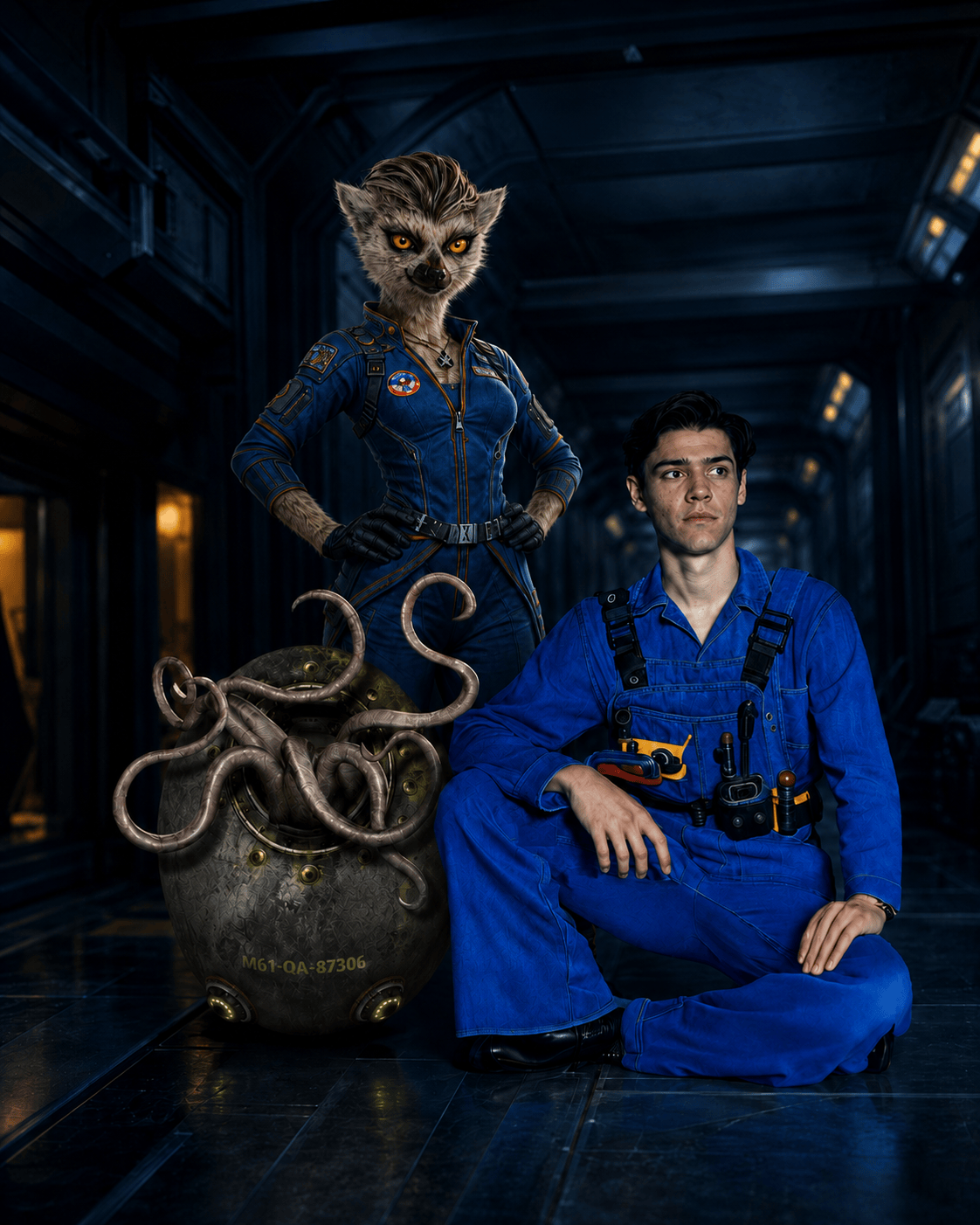
Maroli Tango is science fiction built on an unusually ambitious proposition: what if first contact happened thousands of years ago, the aliens never really left, and humanity reached the twenty-first century without realizing how deeply its history had already been entangled with theirs?
That premise could have produced a conventional secret-history thriller. It does not.
Instead, Maroli Tango becomes a story about sovereignty, dependency, trust, family, faith, technology, and the uncomfortable difference between being rescued and being worthy of partnership.
The immediate problem is enormous. In 2041, the Sun is approaching a river of interstellar gas capable of fueling an extinction-scale solar event. Humanity’s technologically superior neighbors know what is coming. They possess tools that could transform Earth’s chances of survival.
They also have reasons not to hand those tools over.
At the center of the resulting confrontation is U.S. President Carmen Benequista, sixty-two years old, widowed, a mother and war veteran, confronting a civilization whose relationship with humanity predates recorded history. Carmen is neither a chosen-one heroine nor an action figure wearing presidential clothes. Her power lies in judgment, nerve, political instinct, and an almost stubborn conviction that survival purchased through permanent dependence may not be survival at all.
Her answer to overwhelming technological superiority is essentially political:
A sovereign people must eventually be capable of saving themselves.
That argument gives Maroli Tango its backbone.
But this is not simply a novel about presidents, civilizations, and cosmic catastrophe. Its scale repeatedly collapses back to individual lives. Teenaged shipwright Mason Fowlkes is discovering both extraordinary machinery and the considerably more dangerous territory of adulthood. French officer Marie Jourdain becomes part of that journey. Brandon Lopez, security professional and longtime man of competence, finds himself drawn into a late-life romance with a woman whose private choices can never be entirely private.
Those relationships matter because Maroli Tango is ultimately less interested in whether technology can save humanity than in what sort of humanity deserves saving.
The aliens themselves are another strength. They are not a single mysterious civilization waiting to explain the plot. They have nations, institutions, religions, businesses, grudges, families, bureaucracies and conflicting interests. Some are ancient visitors. Some are immigrants. Some are human. Some are decidedly not. Their technology can appear miraculous, yet the people using it remain recognizable in their ambitions, vanities, loyalties and fears.
Even the book’s machines acquire personality. Spacecraft, artificial intelligences, maroli robots, neural implants, grav-lift vehicles and trans-dimensional engineering are treated not merely as spectacle but as parts of a functioning civilization. The result is a future that feels inhabited rather than displayed.
The tone is similarly difficult to categorize. There is space opera here, but also political drama, romance, military science fiction, family comedy and speculative history. Enormous ideas are frequently followed by very human conversations. A discussion capable of altering planetary history may occur beside somebody worrying about a teenager, a marriage, an embarrassing social encounter, or what is for dinner.
That tonal mixture is deliberate. Maroli Tango is not fundamentally about the end of the world.
It is about people who still have lives to lead while the end of the world is being discussed.
And beneath nearly everything runs a question the novel refuses to answer cheaply:
When does accepting help become surrendering responsibility?
Carmen Benequista has her answer.
The aliens have theirs.
And Maroli Tango spends its considerable imagination discovering what happens when neither side is willing to yield.


Leave a Reply